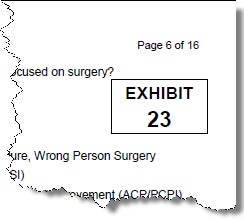
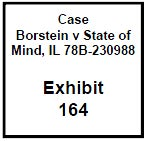
In Colorado, our courts expect exhibit stickers to indicate Plaintiff’s or Defendant’s and have the case number on them.
The job then was to create a dynamic stamp which asked for two lines of input. More importantly, the stamp should be able to be customized.
Mission accomplished and delivered in this blog article!
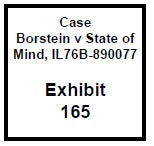
Once applied, a stamp looks like this:
Read on for:
Credits
Download
Installation
How to use the stamp
Instructions on how to customize the stamps
Credits and How it Works
Many thanks to JavaScript guru Karl Heinz Kremer who provided the original sample code and posted it to his blog. I added some additional stamp variations and renamed the stamps so that you can use these stamps along with my original set.
One great thing about Acrobat is that you can add functionality using the JavaScript scripting language. Adobe publishes a free Acrobat JavaScripting guide if you want to geek out yourself!
Download the File
(97K PDF)
Installation
You must install the file in order for it to work. Here’s how:
Quit Acrobat
Place this file in the Acrobat Stamps Folder
Restart Acrobat
Stamp Folder Locations for Acrobat 9 You will need to copy the stamp file into the appropriate folder on your computer. Below are the locations for Acrobat 9. The stamps should work with Acrobat 8. The installation locations for Acrobat 8 will be similar, but you’ll need to figure that out on your own.
Mac OSX /Users/USERNAME/Library/Application Support/Adobe/Acrobat/9.0_x86/Stamps
WinXP C:\Documents and Settings\USERNAME\Application Data\Adobe\Acrobat\9.0\Stamps _ Win Vista_ C:\Users\USERNAME\AppData\Roaming\Adobe\Acrobat\9.0\Stamps
Using the Dynamic Two-line Exhibit Stamps
Choose View> Toolbars> Comment and Markup
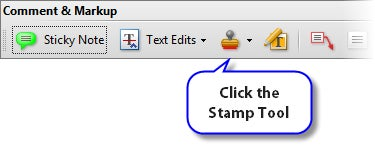
Click the Stamp Tool
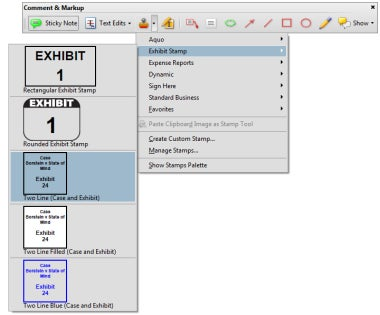
Choose the Exhibit Stamp Category
Note: If you did not install my original exhibit stamp file from my last blog article, you won’t see the first two options. Check out my original post if you want them.Three Kinds of Stamps I created three new two-field stamps: 1) Black text, clear background 2) Black text, solid white background 3) Blue text, clear background
Choose a stamp and click to place it on the document
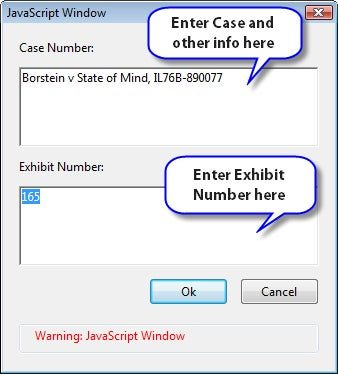
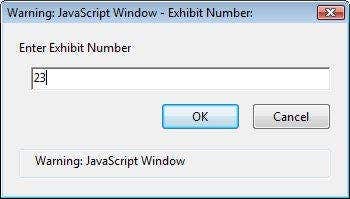
A window opens. Type in some text in the fields:
Tip: Keep the Case Information text on the clipboard and paste it into the stamp window.
The stamp will be placed on the document.
Customizing the Stamp
The instructions below are for Acrobat geeks. If you are pretty good with forms and not scared by a little bit of code, you’ll be OK.
How does this thing work?
The stamp file (ExhibitandCase.pdf ) is a four page PDF. The first page includes some instructions. The following three pages have some “special sauce”:
A page template which provides:
A unique way that the script addresses the stamp
The name of the stamp in the menu
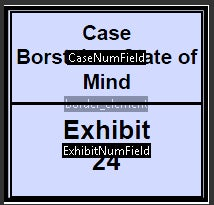
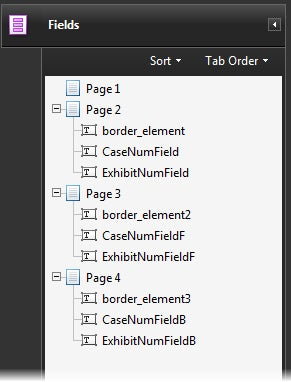
Three Form fields
A background field which provides the border
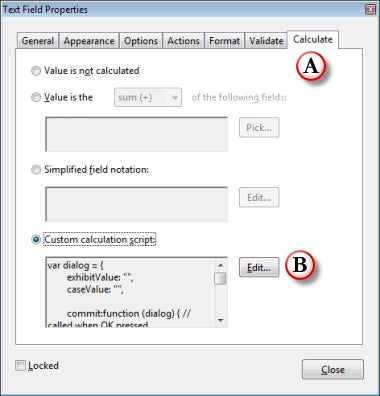
A field for the Case text with an attached script
A field for the Exhibit number
One of the pages of the PDF looks like this:
Making a change in the Stamp
Using the directions below, you can make some minor changes to the existing stamps. I’ll also tell you how you can create additional stamps and add them to the set. Make a backup copy of the stamp file (
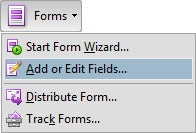
Click the Forms button and choose Add or Edit Fields.
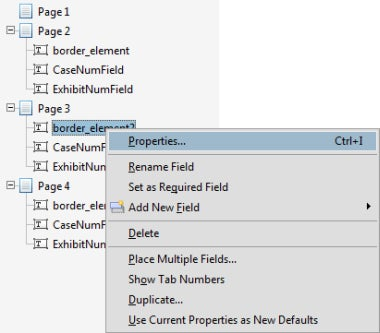
Select any of the CaseNumField and ExhibitNumField fields from the Fields panel.
Right-click and choose Properties.
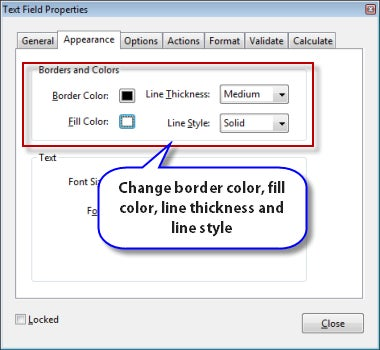
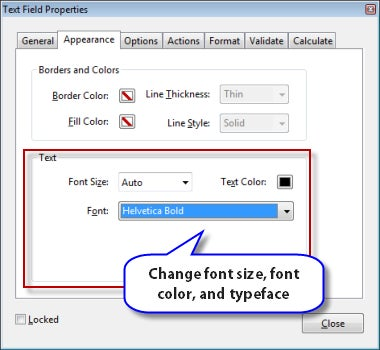
Click on the Appearance tab
You can change the font, font size and font color. If you have to have purple exhibit numbers, you can!
Save the file.
Quit Acrobat and then restart to see your changes.
Changing the Label on the Exhibit Stamp
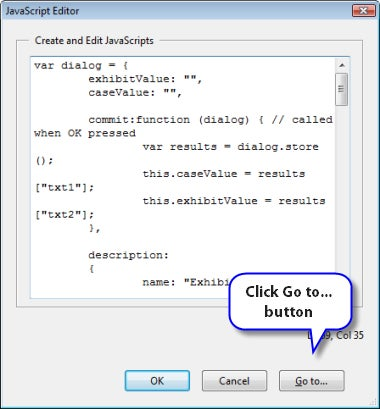
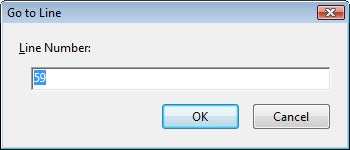
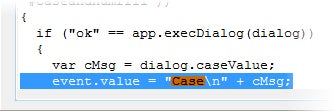
The Stamp labels are generated by the JavaScript which is attached to the CaseNumField. The default labels are “Case” and “Exhibit”. You can change the default labels by editing the script.