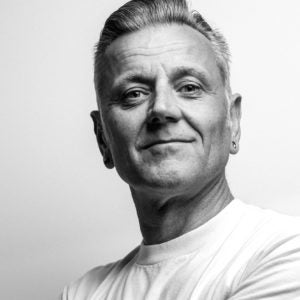

Dedicated. Stubborn. Certifiable. A sucker for punishment. All ways to describe the UK-based graffiti artist, INSA, who recently gained global recognition for his new-school approach to the old-school craft of graffiti, or as he calls it GIF-iti. His approach shows a mad dedication to the traditions of graffiti, where rather than take the shortcuts that Photoshop might allow, INSA chooses to travel the long road, sometimes taking many days to complete a single 600-pixel-wide animated GIF.
He creates his labor-intensive GIF-iti by painting and re-painting the walls of buildings – each time making slight changes – and then photographing each change in order, later creating a looping sequence of images, which make an animated GIF. The biggest challenge and the key he says, is to ensure that the last image layer links smoothly back to the first, which may have been painted a week earlier. His most recent GIF-iti project was a collaboration with artist Stanley Donwood, commissioned for the album release from new supergroup, Atoms for Peace, featuring Radiohead’s Thom Yorke and Flea from Red Hot Chili Peppers.
INSA’s résumé is as eclectic and interesting as his art – reflecting an equal measure of outlaw and convention. He’s been commissioned by companies like Nike, Sony, Kangol and Kid Robot. His work has taken him around the globe where he’s left his unique mark on buildings in Tokyo, Los Angeles, New York, San Francisco, Luxembourg, Lisbon, Hong Kong, Warsaw, Berlin, Brussels and Montreal. And he has spent his fair share of time in courtrooms and even prison, all for his art.
In part one of this two-part blog post, INSA gives us a peek into his process and the urban art culture:
**What inspired you to create GIF-ITI?
**I realized I was viewing more paintings online than in real life, the majority of art I was accessing was on the internet. Whether that was street art from around the world, or exhibition openings on blogs, and it disheartened me a little, because although it was great to be able to see so much work, I realized this was never the way the artist would have intended for their work to be seen. So I thought an interesting way to play with this idea was to create art specifically to be viewed online: to the point that you could not actually see it in reality. So, in fact, the internet becomes the best viewing platform for the work.
**Describe your creative process and how you incorporate Photoshop into your workflow.
Do you think in terms of what you’ll eventually do in the software (Photoshop), or does that come later?
**Photoshop generally comes in at the end, when I’ve done all of the painting and photographed all of the layers. I upload and overlay all of the images and create a GIF. The process is more about the physical act of painting numerous frames, and involves a lot of mental planning, every stage of painting has to preempt the next step, and the final frame needs to lead into the first in order to create a good looping GIF. The thing I enjoy about this process of painting a GIF is that it begins where most artwork ends.


