New Adobe Experience Manager + FrameMaker Integration Facilitates Great Customer Experiences.

Today’s digitally sophisticated customers expect a broad spectrum of content to be available as they research their purchasing options. It is becoming evermore common for potential customers to expect to read user manuals, service and repair guides, and other technical documentation before making their purchase decisions – especially in industries where both the sales cycle and the product is complex.
When technical communication is unavailable or doesn’t display optimally on users’ devices in the manner we already expect marketing content to, end users often become frustrated, confused, and unable to accomplish what they initially set out to do. If your technical communication is causing frustration, your customers — as well as your potential customers — are likely to direct that frustration at the product and not at the help and support documentation. It is all too common that such frustration turns into dissatisfaction with the product AND the brand.
Existing customers are demanding technical content that is natively published across all channels, mobile devices, and formats, including mobile apps. They also want it delivered and displayed faster with useful personalization filters in place to enhance their consumption experience. They want the technical information to be easily consumable, easily searchable, interactive in nature and immediately actionable. These challenges that use to only plague marketers are now extending to technical communicators as well.
Unfortunately though, most companies that produce technical content for their products are still producing unstructured documentation that doesn’t translate well onto mobile devices, which is where most people are attempting to view it. Customers equate poorly presented documentation as an indicator of less-than-optimum product quality and performance.
Companies that ARE creating DITA-based technical documentation that plays well in the multichannel world often have it hosted on yet another platform within their organization. This creates another silo that complicates your ability to understand the customer journey, resulting in poor customer experiences across purchase and use of your products.
Sales Cycle Impacts
Gone are the days when you had the luxury of getting phone calls from confused customers. Today, consumers would much rather tap or swipe their ways to your competitor — one that may have an integrated platform that creates a smoother, more consistent pre- and post-purchase customer experience.
To address this problem, Adobe has recently integrated the popular Adobe FrameMaker document-authoring-and- publishing application with Adobe Experience Manager. This integrated solution speeds up the delivery of technical content on the market-leading platform that has helped marketers deliver compelling digital experiences.
“Our tech doc team manages a library of over 200 technical guides, and typically publishes over 25 guides each month, said Kathy Miller, Senior Director at CyberSource, a Visa company. Given our Agile software development methodology, we operate with short release cycles and need to reuse a lot of common content across our library. To increase efficiency, we wanted to find a solution in which we could author, review, approve, and publish all within the same tool set. And, since we currently author our content in FrameMaker, it made sense to stay in that environment to reduce the team’s learning curve. Adobe’s solution will allow us to do this, as well as help streamline our localization process.”
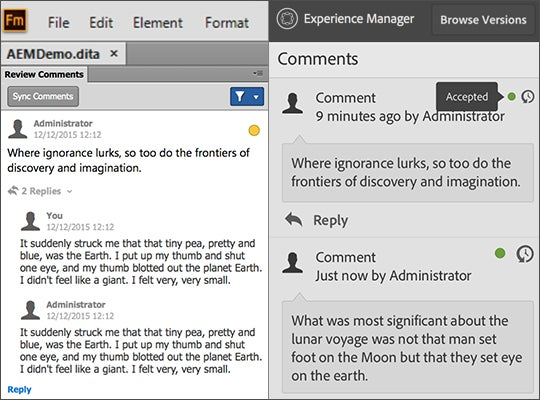
For almost three decades, FrameMaker has been keeping pace with demanding technical-communication needs for small-, medium-, and very large-scale documentation environments. Its integration with Adobe Experience Manager represents a full appreciation of the changing needs of your multichannel customers, as they do the majority of their work on mobile devices.
Combine Your Component- Content Management and Web-Content Management
There are powerful advantages to storing your technical documents along with your other content in a digital asset management system (DAM). Document managers and creators will have access to your entire content collection, and marketers will have easy access to technical documentation. Additionally:
- You can measure and gain insights into how customers are using your documents in the context of your entire content collection and customer journey. This can inform product production and innovation strategies as well as help you optimize your marketing initiatives.
- You can track what your customers are searching for within your documents, providing insights into what content you can further recommend that would be most helpful and lead to cross-sell opportunities.
- Technical-communication teams, like marketing teams, will be able to measure the impact of their efforts on customer engagement and other business objectives.
- Marketing data about customer needs becomes more available to document teams, ultimately providing opportunities to create more relevant documents designed in response to customer needs.
- Just as technical-communicators will have greater visibility regarding how their efforts directly affect customer satisfaction and business success, marketers will see how good documents can enhance — even accelerate — a complex sales cycle.
“The XML Documentation Add-on for Adobe Experience Manager and seamless integration with FrameMaker show Adobe’s commitment to supporting the growing needs of companies by addressing the full XML workflow of creation, editing, review, and publishing,” said Maria Casino, Marketing Manager, Intersil.
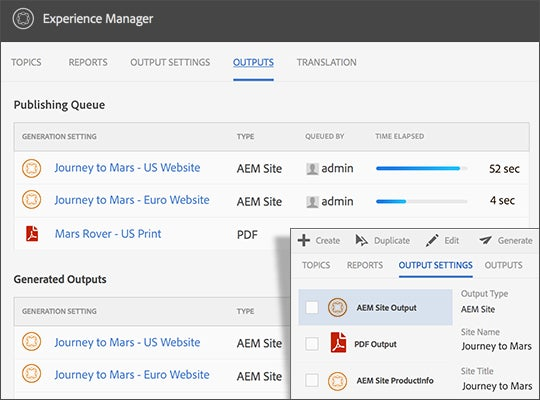
Great technical communication that meets customer needs can attract and convert customers, sustain client relationships, and turn your users into brand advocates. Integrating technical communications with marketing initiatives enables companies to provide the most relevant content at every stage of the customer journey.
With this FrameMaker integration, Adobe Experience Manager becomes the single platform for marketing and technical communication departments. It is both the leading digital experience platform for marketing and now, also a full-fledged enterprise-class DITA CCMS for technical communications.
To deliver the seamless experiences that customers demand, a digital experience platform must span across organizational silos to drive greater customer insights and deliver the right content in the moment that matters.
For additional information:
Read more about the solution: http://www.adobe.com/products/xml-documentation-add-on-for-experience-manager.html
Sign up for a webinar on August 30 to learn more: https://2016-08-30-aem-dita-ccms.meetus.adobeevents.com/