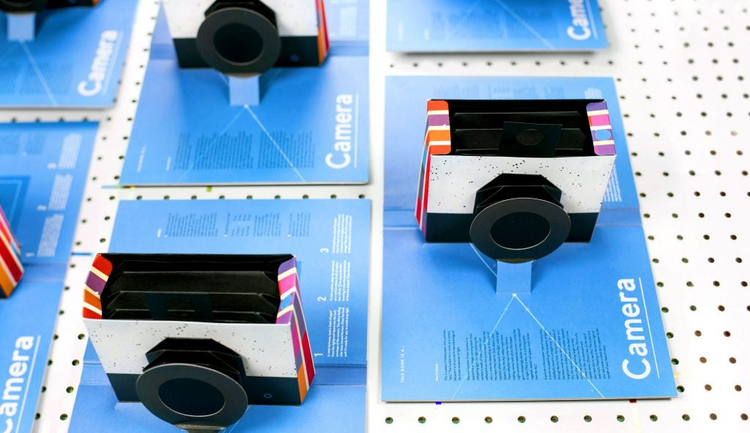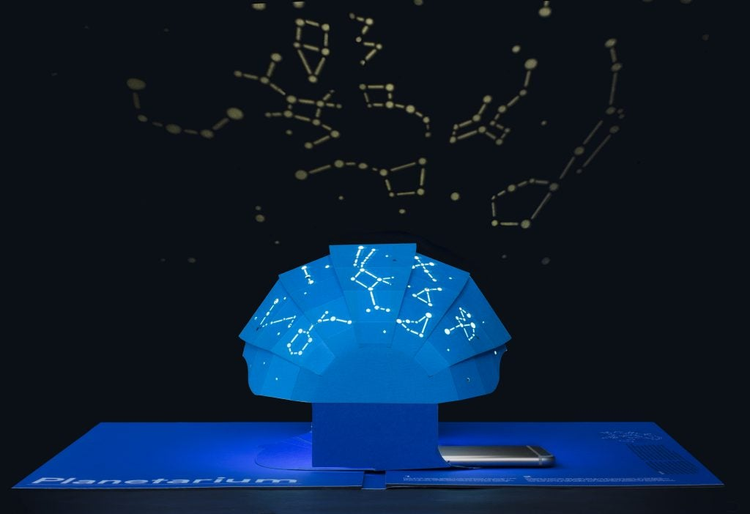
Kelli Anderson is a designer, author, and all around creative innovator. She was also one of Adobe’s very first Creative Residents, and she’ll be speaking at Adobe MAX 2017 in Las Vegas, Oct. 18-20. We talked to Kelli about her work, her MAX session, her unique and delightful book, “This Book is a Planitarium: And Other Extraordinary Pop-Up Contraptions,” and about the concept of designing for good.
Q: The design field is ever-evolving. How do you keep up with the changes and evolve as a designer? Do you find it necessary to continue learning and experimenting with the technology? What do you do to foster your creative growth?
A: As a ‘professional’ it is hard to admit this (but someone has to do it!): I make better work when I’m new to something. When I don’t completely know what I’m doing or what to expect out of the process, the work is often more successful than when I feel like I ‘have a handle on it’. Because of this, I’m eager to experiment with new technology and just see what happens. (Since I don’t know exactly what to expect, I waste no time thinking about strategy or motive and get straight to considerations internal to design itself. It forces me to respond to what’s in front of me, not my preconceived notions about what should be there.)
Q: How do you handle a creative slump? Any favorite places for inspiration?
A: I read kids’ science experiment books (seriously!). But I also like to escape media and just see what’s happening in the world. I love going to the art book fair, to the Arm (which is a community printspace down the street from me), and Chelsea galleries. Lately, political protests have felt very inspiring (the signs are way-good!) Sometimes it’s hard to tell whether a slump is idea- or mood-related. Having physical places that make me feel inspired is a necessity in my life.
A: Yeah—so the new book is called This Book is a Planetarium and it contains a pop-up planetarium, a strummable musical instrument, a geometric drawing generator, a perpetual calendar, a message encrypter and decoder, and a speaker that amplifies sound.
I wanted to reduce familiar gadgets down to just paper—to show that a lot can be done with very little—but also: to _demonstrate _(rather than just “telling”) that the physical world is amazing in ways we totally take for granted. Because each pop-up works (despite exhibiting no apparent technology), the book enables an intimate, firsthand vantage point on invisible forces at play in our world. The book also concisely explains how paper can be structured to tap into the larger phenomena of light, time, soundwaves, and mathematics in order to make lo-fi magic.
It is kind of a science book for people who are better at feeling things out than they are at math.