Emma-Victoria Houlton: Musician, Producer, Storyteller
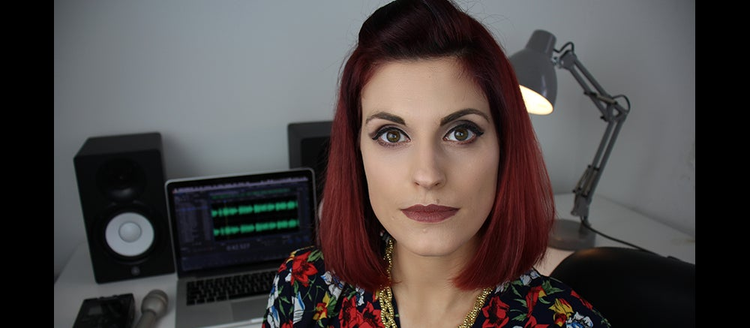
Courtesy of Emma-Victoria Houlton.
Young Emma-Victoria Houlton felt on top of the world. She’d just earned a music degree and was playing in a band. There she was, at 22, recording with her band at the local BBC Radio station when all of a sudden, out of the blue, she fell in love. With radio.
Watching the producers and sound technicians at work, it just hit her. “Immediately, I was hooked,” she says. “I knew I had to be a radio producer.”
Emma had fallen hard for the art of audio storytelling and set her sights on a new career. She scored an internship at a hospital radio station, where she learned the ropes and helped produce a weekly morning show. And after a year of interning, she returned to school to pursue a master’s degree in Radio Production at Bournemouth University.
A fateful pitch
As part of the master’s program, the students had to pitch a radio documentary to the commissioning editor at BBC Radio 4. “It was a great opportunity, but I had to come up with a really great story,” says Emma. “That BBC editor had a reputation as being a tough critic.”
But Emma had a good ear for a story. She remembered an incident that her father had told her about his favorite band, The Who. Back in 1973, while performing at the Cow Palace in San Francisco, drummer Keith Moon downed a cocktail of horse tranquilizers and brandy and subsequently collapsed on his drum kit. Needing a drummer, Pete Townsend called out to the crowd “Is there anybody out there who can play drums?” A 19-year-old kid emerged, got behind the drums, and played the rest of the show.
Emma pitched the idea. The commissioning editor loved the story and couldn’t believe the BBC hadn’t already covered it. Thus a career in storytelling and radio production was born.
Building a career in audio
In 2010, with “Who’s Drummer” and a master’s degree on her CV, Emma landed a job as an audio producer with broadcast networks including the BBC, Sky TV, and RTE News. Over the next few years she worked on a range of successful radio programs, and was early to understand the potential of web programming—especially podcasting.
“I started doing podcast gigs on the side,” she says. “I’d come home from my day job and start working for my Canadian and American clients. Soon, I was earning more money at podcast gigs than at my full-time job.”
Through it all—from her days mixing music in a band to producing podcasts—Emma has relied on Adobe Audition. “I learned to edit on Adobe Audition and it’s the only software I’ve really used or needed,” she says. “Whether I am mixing music, editing a client piece, or stitching together one of my own stories, Adobe Audition has all the core tools in one app, and they’re really good. I don’t need to jump between different tools or spend a fortune on plug-ins. Audition has served me quite well over the years.”
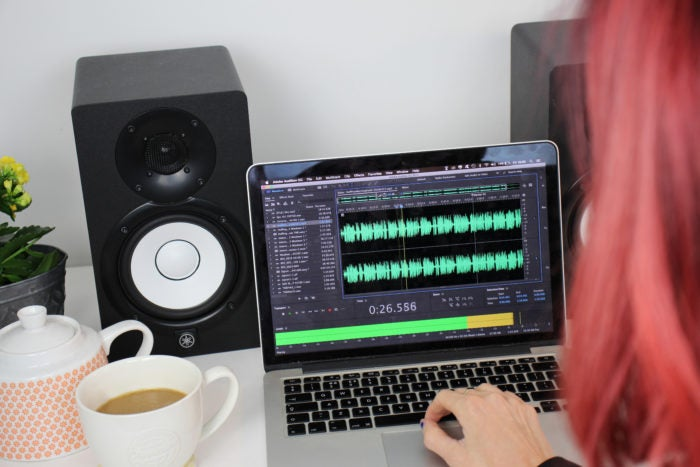
Courtesy of Emma-Victoria Houlton.
A new medium for storytelling
Today, Emma specializes in voiceover work and audio production. She runs her own company, Art of Podcast, and current clients include the United Nations, HuffPost, AOL, Goldsmiths University of London, and Ernst & Young. In addition to her client work, Emma is writing and producing a new series titled Human.
“We aim to get the heart of who people are and why they do what they do by telling compelling audio stories using podcast content and other audio content,” says Emma.
Every day, she produces the HuffPost Morning Email Flash Briefing on Amazon Alexa, which details the day’s most important news. She receives the audio file from Washington, D.C. and cleans it up, doing some noise reduction and applying Audition presets that the HuffPost team provides.
“I’ve found that the volume of any music beds needs to be reduced under the speech to make the voice stand out in a Flash Briefing,” says Emma. “I complete the final mix using my on board Mac speakers. If it sounds good on those tiny speakers, it will sound good on a smart speaker.”
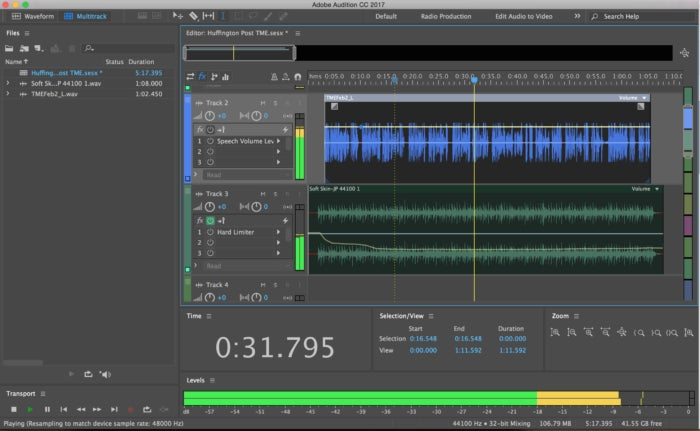
Courtesy of Emma-Victoria Houlton.
Good audio editing is about creating a world through sounds and storytelling. A recent project for Goldsmiths involved editing a three-part program about gentrification in an area of London called Peckham. Emma interleaved sounds of the train station and car park with audio from the sociologists who were studying the changes in the neighborhood. By using noise reduction and the Hard Limiter effect, Emma was able to attenuate the audio and make everything work together.
“Audio is an intimate medium, and if you lose the nuances of voice it doesn’t have the same impact,” says Emma. “With Adobe Audition I can fix distortion, loudness, and clarity in podcasting and radio content so listeners can really focus on the content.”
Emma-Victoria Houlton is participating in the Adobe roundtable “Podcasting and the Future of Audio Storytelling” on Tuesday, April 10th at 4:00 PM, which will be streamed live on Adobe CC Video & Audio Facebook page.
She will also be presenting in the Adobe booth SL4610 at NAB 2018 on Tuesday, April 10th at 12:00 PM. Her presentation on Wednesday, April 11th at 1:00 PM will be live streamed on the Adobe Premiere Pro Facebook page (@premierepro).