Personalizing the Customer Journey at Scale with #PerfectPath
Personal treatment. Customers crave it, but it’s hard to provide. A small brick-and-mortar business has the opportunity to get to know their customers over time — what time they usually visit, their typical purchase, their mood, and personal tastes. Even salespeople at big-box stores can intuit a lot about a customer from their style of dress and a few seconds of interaction. These physical, real-world cues make it easy to welcome repeat customers with familiarity, provide recommendations, and reward loyalty.
Creating personalized experiences in the digital world is much trickier. Digital experiences need to work at scale. Instead of dozens or hundreds of customers a day, digital brands need to interact with thousands of customers every minute. And while analytics data can provide a wealth of data about a customer’s previous online behavior, it’s often anonymized and impersonal.
“Digital marketers are typically responsible for running several campaigns, with multiple user touchpoints, all concurrently,” says Pankhri Singhai, a product manager for Adobe Campaign. “The goal is to help customers find what they need with the right message at the right time. To do that, the marketer starts with data but ends up making a lot of assumptions about the association between data, observed behavior, and what part of the life cycle the customer is in or what they might be interested in next.”
It turns out that knowing a lot about a person’s demographic details and online history is an imperfect way of really knowing who they are, how they are feeling, and what they might expect from you today.
“The risk is that personalization can end up feeling superficial, based on simple data like knowing their name or birthday, rather than their real-time behavior,” Pankhri says. “The other thing that can happen is customers end up getting off-target messages, or worse, multiple conflicting messages from a brand. Instead of feeling personalized, it just becomes overwhelming and disjointed.”
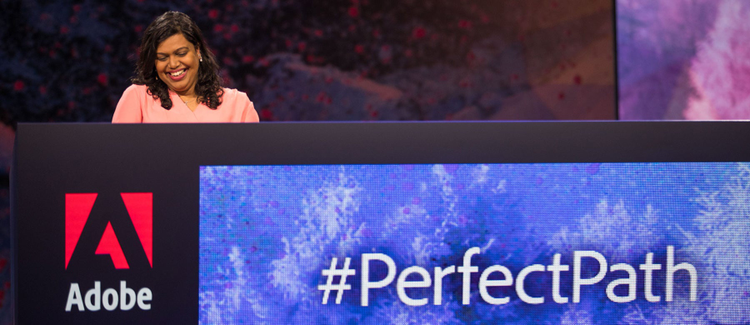
Pankhri wanted to see if it was possible to leverage the power of artificial intelligence (AI) to make better use of data at scale and optimize a personal customer journey. The result is a sneak technology called #PerfectPath, recently demonstrated at Adobe Summit.
#PerfectPath will leverage Adobe Sensei AI to analyze the vast amounts of anonymous customer data a website collects about its visitors, comparing known behaviors and desired outcomes such as engagement or conversion, and then predicts which customer journeys, paths, offers, and touchpoints are most likely to result in the desired customer outcome.

#PerfectPath uses Adobe Sensei AI to analyze user segment information and recommend optimal, personalized customer journeys.
“For example, with #PerfectPath, the marketer can identify a known behavior — such as abandoning a shopping cart — and generate a customer journey that is likely to be successful at re-engaging them and driving conversion. It works by analyzing experiences with all the site’s previous visitors, what they had in common, and what combination of touchpoints resulted in the best outcomes,” Pankhri says.
Pankhri goes on to explain that #PerfectPath provides the marketer with three key advantages:
- Control of the criteria and parameters that define the customer journey.
- A visualization of the customer journey, down to and including segment journeys for different groups of customers.
- Insight into the journey predictions.
“It’s not a black box,” she says. “You can control the input, see the output, and understand why the recommendation has been generated and the data behind it.”
As for what’s next? “I’m really excited to share this concept technology with more customers, collect their feedback on what they find useful, and see what aspects of this technology might be appropriate to integrate into Adobe Campaign. I’ve always been interested in marketing and customer behavior, but I’m an engineer at heart, and this project is a great opportunity to bring all those things together.”
View this and other Summit sessions on demand and read more stories from Adobe Summit.