Our Upcoming Drawing and Painting App has a New Name: Adobe Fresco
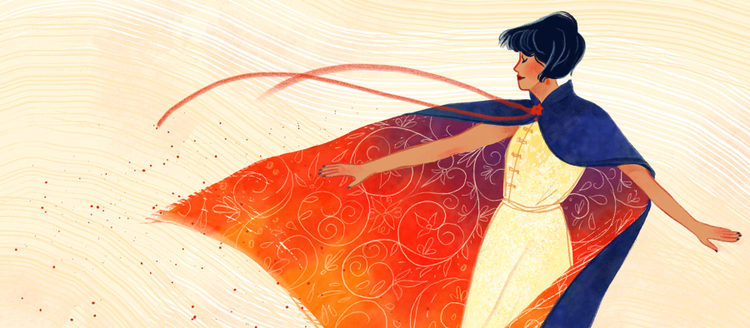
“In The Wind” by Jinjin Sun.
Drawing is fundamental to developing creative literacy. It is most people’s first connection to creativity, and every great painting, sculpture, film, or building began with a drawing. And today, more than ever, it’s essential for everyone to develop creative literacy. As artificial intelligence takes over more and more repetitive and mundane tasks, creativity is the unique human quality that sets each of us apart and helps us succeed.
Connecting brain and hand through drawing unlocks creative magic. To forge that connection, a digital generation needs a digital tool, which is why we’re developing a powerful and sophisticated drawing and painting application.
We gave a sneak peek of that application last fall under the codename Project Gemini. Now, as we’re approaching final release of the app later this year, we’ve named it: Adobe Fresco. Understanding how we arrived at that name will help you understand a lot about the app itself.
Video and artwork by Kyle Webster.
For those of you who have forgotten your art history, fresco (‘fresh’ in Italian) is a painting technique that has been used for centuries all over the world. The artist spreads a layer of plaster on a wall or ceiling, then – while the plaster is still wet – paints the image using a simple mixture of pigment and water. A chemical reaction binds the pigment to the still-wet plaster and the image becomes a part of the wall. Once the plaster is dry, the painter has to stop – the chemical magic is gone.
That last fact expresses something important about creativity. When inspiration strikes, you have to act before the plaster dries. We’re developing Adobe Fresco to empower spontaneous creativity. Because it’s built for the Apple iPad (with versions for other stylus- and touch-based devices to follow), you’ll be able to bring Fresco wherever you go. It frees drawing and painting from the desktop and lets you create everywhere, anytime.
The fresco technique also makes it clear how organic drawing and painting have always been. For generations, artists have distilled pigments from plants and minerals and created through the physical interaction of chalk, oils, and watercolors with paper, canvas, and plaster.
Adobe Fresco will replicate those organic interactions and expand on them. Adobe scientists have studied the chemistry of common real-world pigments like cobalt and ochre. They’ve looked at the physics of how watercolors are absorbed into thick, cotton-based paper. And they’ve examined the ways that a thick slash of oil paint dries to add dimension to a painting.

“Turtle” by Paul Trani.
The result is Live Brushes, which use the artificial intelligence of Adobe Sensei to recreate the behavior of oils and watercolors in an amazingly lifelike way. When you paint with a watercolor Live Brush, you’ll see the color bloom into adjacent areas of the paper. Use red and yellow next to each other and they’ll naturally blend into orange at the border. You can even recreate painting with water to dilute some colors and encourage tints to mix.
With an oil Live Brush, you can slather on a thick coat of paint and see the ridges and brush strokes that give the painting dimension. And you can mix different oil colors together to create a varied swirl of color that no digital color wheel could ever provide.
Live Brushes are something that no other drawing and painting app can match. But they’re not all Fresco offers. You can use all your favorite Photoshop brushes directly in Fresco, and get access to thousands of additional brushes created by famous digital brush maker Kyle Webster. Photoshop brushes can do things real-world brushes can’t, such as building stamps from shapes like stars, people, trees, or grass. And Fresco includes vector brushes, which create clean, crisp, and infinitely scaleable lines and shapes. You can even create your own brush using Adobe Capture. Fresco’s brushes combine the qualities of real-world painting and digital creation in a unique and sophisticated way.
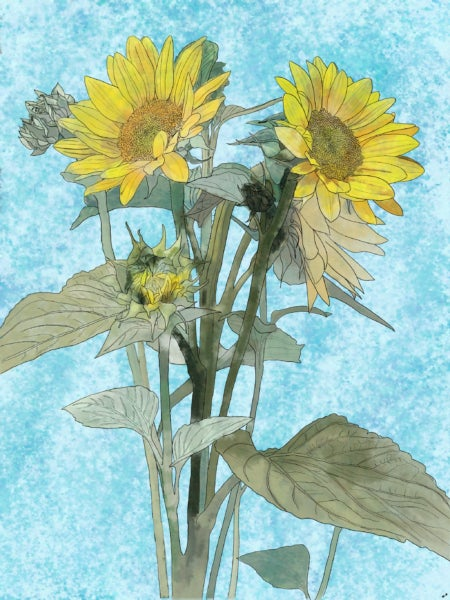
“Sunflower” by David Every.
Fresco will have the power creative professionals need. It includes pro-level tools like layers, masking, and selection in a workspace you can customize for efficiency. Fresco works seamlessly with Adobe Photoshop, allowing you to move your drawings between the apps. It also supports export to PDF for editing within Adobe Illustrator.
As powerful as Fresco is, though, its streamlined interface is also accessible for anyone who just wants to draw. French-American illustrator and animator Pascal Campion is helping us test Fresco, but he can’t always get on the app – because his kids love it, too.
We’re developing Fresco for a broad spectrum of seasoned to novice artists and anyone with the right hardware will be able to draw and paint in Fresco for free. (Want to try Fresco before it launches? We’re slowly adding more users to our pre-release testing and you can apply here.)
Soon, millions of people will have this incredible tool in their hands. I can’t wait to see what they produce.