Sentiment Analysis: A Key to Measure and Improve the Customer Experience

Image source: Adobe Stock / magele-picture.
Verbal communication has been the key enabler for exchanging ideas and influencing decisions among humans for ages.
The modes of verbal communication have evolved over time from mere interpersonal interaction to broadcasting ideas and opinions to the whole world, thanks to the advent of television and radio, followed by the internet and social media.
But social media in particular has drastically altered the landscape of customer interactions and engagements with brands and businesses. This, in turn, has empowered customers as they now have numerous platforms like Facebook, Twitter, blogs, forums, app stores, etc. to openly share their experiences on various products and services.
Brands can use these interactions/data points to assess customer opinions and sentiments and adapt readily to meet the changing needs of the customer. However, the evaluation and interpretation of data across these platforms pose a huge challenge to brands and businesses. This is where tools like sentiment analysis can be leveraged to gather meaningful insights from the data.
Traditionally, brands relied on structured surveys and questionnaires to gauge customer satisfaction. The Net Promoter Score (NPS) survey classified customers into promoters, passives, and detractors based on a few simple questions (e.g., “Would you recommend this company, product, and/or service to a friend or family member?”). The survey data can be easily aggregated and assessed but it does not provide additional insights on customer behavior and experience. This is where sentiment analysis comes into play.
Sentiment analysis is the process of identifying and extracting customer’s opinions and sentiments exhibited in a text. The analyzed data quantifies the customer’s sentiments and reactions toward certain products, services, or ideas, and reveals the contextual polarity of the information. Customer sentiment can range anywhere from positive, neutral or negative and no matter where customers are in the sentiment spectrum, sentiment analysis provides information on the key drivers of customer sentiments. This valuable data is a gold mine for brands and businesses as it helps them refine their products, services, brand image, and more.
Customer opinions are usually subjective expressions that describe sentiments and feelings toward a subject or a topic. Opinions can be direct (e.g., “The app does not have a user-friendly interface”) or comparative (e.g., “Support provided by Brand A is better than that of Brand B”). Opinions can also be explicit (e.g., “The product quality is very bad”) or implicit (e.g., “The product broke in two days”), which is the most difficult type of opinion to analyze.
The other complication is the way in which the words are combined in a sequence (e.g., Although “bloody” is a negative word, it may be a positive indicator if used in a phrase “bloody awesome”). Sentiment analysis overcomes these challenges and helps businesses in formulating actionable insights. It also helps in identifying recurring themes/issues (e.g., “Customer service is very slow,” “Competitor B has integrated facial recognition feature on the app,” or “Adding XYZ as one of the payment methods would be recommended,”) which can help businesses understand challenging customer experiences, competitive threats, and emerging market opportunities.
There are three ways to implement sentiment analysis systems: Rule-based systems, automated systems, and hybrid systems.
Rule-based systems
The simplest kind of sentiment analysis systems makes use of dictionary/lexicons to look at words or phrases and indicate the sentiments associated with it.
There are some popular off-the-shelf lexicons like Simply Sentiment, VADER, TextBlob, Sentiwordnet, etc. which do this job easily. There is not much training involved as this system is simple, fast, and relatively easy to use. The accuracy is decent with steady outcomes, but it does not consider how words are combined in a sequence. Hence new rules need to be added to support new expressions and vocabularies. This kind of approach works well with direct and explicit opinions. However, rules need to be customized/added for comparative opinions, and it does not work well with implicit opinions.
Automated systems
Automated systems use a mix of statistics, natural language processing (NLP), and advanced machine-learning algorithms to determine sentiments. In this technique, the models are trained to associate inputs (texts) with corresponding outputs (classifications). The machines are trained on models/classifiers with the input data that is already classified. Once trained, the model is then tested on more data and this time the model generates the predictions.
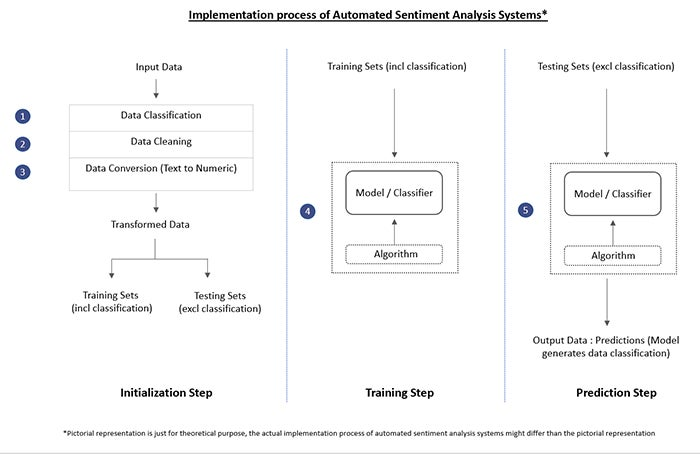
ML-based systems are dynamic in nature as the models learn and adapt over time. Hence, they cannot only work on direct, comparative, and explicit opinions but also on implicit opinions. The results are more accurate compared to rule-based approaches, but this also depends on the size and quality of the data provided for training in the first place.
Hybrid systems
Hybrid techniques combines the best of both worlds, rule-based systems and automated systems. These systems are more powerful as they contain more emotional information gathered from the lexicons which can then improvised to adapt, based on the needs. Usually, by combining both the approaches, the system can improve accuracy and precision.
Sentiment analysis in action
All these 3 systems are widely used by brands and businesses for social media monitoring, brand reputation monitoring, customer service analysis, product analysis and workforce analytics.
For example, Starbucks monitors its brand reputation on social media. Nonprofit organization American Cancer Society (ACS) monitors audience feedback on programs and events. It uses software that is trained and tested to achieve better results. For instance, although both the words “Kill” and “Cancer” could indicate a negative comment, “Kill Cancer” is positive for ACS. The organization had to teach its software to identify this exception.
Additionally, Finnish outdoor equipment giant Suunto Oy tracked user-generated content when they launched their Spartan Ultra watch. The product had a few technical issues and customers were open about it. The company tweaked the product by recognizing the problem areas, thus damage to the brand was kept to a minimum.
This is just a snippet of what sentiment analysis systems can accomplish and how they can impact the brands.
Sentiment analysis takes your CX to new heights
Today, customer experience has become the top priority for brands. As per Gartner, customer experience is proving to be the only truly durable competitive advantage. They found that 89% of companies today compete primarily based on customer experience, up from 36% in 2010. According to McKinsey, 85% of customers purchase more after a positive customer experience and 70% of the customers purchase less after a negative customer experience. Hence not focusing on customer experience can be a costly endeavor. The mantra to win the battle of customer experience lies in uncovering meaningful and valuable insights from customer data.
Customers today generate humongous amounts of data daily across multiple channels like website, social media platforms, play stores, apps, offline, etc. Data from these channels are collected and stored in independent point solutions, causing data silos. Unveiling customer sentiments from independent sentiment analysis systems and mapping it with customers’ data across multiple channels, to provide enhanced customer experience, become complex and time-consuming.
With the advent of Adobe Experience Platform, these data sources can be unified easily thanks to several features — Experience Platform Data Ingestion, Data Governance, and Experience Data Model (XDM) — to name a few. In addition, instead of having a separate point application for sentiment analysis, brands can leverage Experience Platform Data Science Workspace fueled by Adobe Sensei machine learning and artificial intelligence technology to build automated/hybrid sentiment analysis systems. Data Science Workspace’s sophisticated and easy-to-use tools can train and tune the sentiment analysis model to understand comparative and implicit customer opinions.
Customer sentiments can now be easily mapped to interactional, transactional, and operational data to build a single view of the customer. Brands can build rich audience profiles and use it to target and deliver personalized, relevant, and superior customer experiences that brands are striving for to stay ahead in the present competitive landscape.