VFX Studio Perception uses Premiere Pro and After Effects to create Marvel’s Black Panther: Wakanda Forever title sequences

The much anticipated Black Panther sequel, Black Panther: Wakanda Forever, made its streaming debut on Disney+ this month. The Marvel film pays an emotional tribute to Chadwick Boseman who played King T’Challa, a.k.a. The Black Panther, and explores the real-life stages of grief and loss. Marvel Studios brought in VFX Studio Perception to design the powerful ending title sequence, which — like many Marvel end sequences — was loaded with hidden meaning. The Perception team relied on Adobe After Effects and Adobe Premiere Pro, tools they have trusted for years, to craft the sequence, noting the collaborative nature and ease with which they could move between the two.
Directed by Ryan Coogler, the film tells the story of the people of Wakanda who fight to protect their home from intervening world powers while mourning the death of King T’Challa. Set a year after King T’Challa’s funeral, the film follows his sister Shuri’s internal journey towards healing as she comes to terms with her brother’s death, leading up to a powerful end title sequence that [SPOILER] sees her funeral clothing burning prior to revealing the new Black Panther suit — symbolizing her passing grief and readiness to move forward.
When creating the title sequence, Perception was assigned the challenging task of burning the cloth in the wind outdoors, making it difficult to control the flames. They were able to edit the raw footage in Premiere and After Effects, which helped them identify interesting moments to focus in on as the suit was revealed.
“It is wildly powerful and easy to switch between Premiere and After Effects,” shared chief creative director Doug Appleton.
We sat down with Perception’s creative team Doug Appleton, Greg Herman (creative director), and Christian Haberkern (Art director & cinematographer), who shared more about their use of Adobe’s Creative Cloud tools to create the emotional ending title sequence, as well as other contributions to the film.
How did you first get into motion design? What drew you to it?
Appleton: For me, the first time I saw something that I was intrigued by was the title sequence for Sam Raimi’s second Spider-Man movie. It was the first time there was a title sequence that I saw that made me realize “someone made this, people work on this”. During my time at school, I was interested in a company called Buck in LA, and it was a huge motion design studio. Between my studies and my internship, I knew that going into the motion graphics space was what I wanted to do.
Haberkern: I was a pre-med major in college and honestly, I wasn’t passionate about it. I wanted to do something in design, something specifically with video. I applied to SCAD and once I was accepted, I transferred there. I didn’t even know what I wanted to major in, but I saw the major for motion design and it encompassed everything I wanted to do, from design and motion to animation and video. I didn’t know what I was getting myself into. One day, my professor started showing us things from the bigger studios like Buck and Stardust and all those great motion design studios, then I saw the title sequence for Zathura and I was like yep, that’s what I want to do.
Herman: I was playing in my band and I created designs for our t-shirt sales. That’s where I learned Photoshop and basic graphic design. Then from there, I discovered a few motion design studios. MK12’s short films and GMUNK’s early work were very influential to me. I was fascinated by it. I learned After Effects and didn’t sleep for a week because I was so invested in it — it’s Photoshop with a timeline! How cool!
What was the inspiration behind your title sequence? What were you trying to achieve?
Appleton: The inspiration was the movie itself but in a very specific way. Black Panther: Wakanda Forever had some key moments in it that kicked off our journey on this. It’s this idea that the movie itself is about grief, accepting that grief, and coming to terms with it. In the movie early on, Queen Ramonda wants to do a ritual of mourning where she and Shuri will burn their funeral clothes to symbolize the passing of grief. Shuri refuses to do it, but by the end of the film, she does and that’s the final scene. So when we were crafting the idea for this title sequence, it felt like a powerful idea to have the audience sit in that moment with Shuri and do the ritual of mourning, not only for the character of T’Challa but also for Chadwick Boseman and maybe even others that they have personally lost. We want the audience, characters and creators to all have this moment to all mourn their friend.
How did you begin this project? Can you talk about the collaborative process with the director and the process of creating the sequence from start to finish?
Herman: Marvel Studios and Ryan Coogler were very open to our process and let us go through the steps that we needed to take to get to where we were headed. They were quick to give feedback and give us great insights and direction. But also, we had an elaborate creative process. It started with shooting the entire title sequence with specific cameras, and then realizing that we didn’t like those lenses and cameras. Autumn Durald Arkapaw, director of Photography on Black Panther: Wakanda Forever got involved and gave us great feedback and helped us obtain the proper camera and lenses that were used on the film. The equipment we used was a Panavised Sony Venice 2 camera with Panavision Auto Panatar Super Speed Anamorphic Lens. This helped our sequence have the same visual continuity as the rest of the film. We went and reshot everything with the updated camera and lens package. You do it twice, you do it nice! Maybe the second time through was the magic that we needed. For me as a designer, I’ve designed so many sequences that when I go back and design it a second and third time, that’s when I get it right, put the polish on it or make a great realization about something. That’s the process we went through and Marvel Studios was extremely supportive of that.
Appleton: We always knew we were going to have multiple shoots. The first shoot would be about finding the sequence because when you work with fire, cloth, wind and the outdoors, it’s all unpredictable and we want to make it as predictable as we can. That first shoot was our test. Once Marvel Studios saw our work, it became a very collaborative process. The DOP got involved and we had a very close collaboration. She shared how she shot the movie and her lenses and how she did everything. It became a back and forth, working closely when we got into the second round of shoots. We had everything we needed to make it as successful as possible.
Haberkern: Autumn was texting me in real time as we were shooting and I would send her our selects and she’d get back to me like “Yeah, that's sick!” It’s encouraging as we’re trying to dial in the look for everything. And her hooking us up with the Panavision gear to film everything which was incredible and elevated the look beyond the simple gear we had.
Describe your favorite part or component of the title sequence. How did it come together and how did you achieve it?
Herman: My favorite shot would be the Letitia Wright card where you start to see the suit come through the burning cloth for the first time. There’s a process you go through watching this sequence where you start to see the cloth burn and connect it to the storyline of the film. You go through the process of what it means and thinking about loss. All of these possibilities happen and that’s interesting, but then you see the cloth move away and the first hint of the suit behind it all. That's a powerful moment because it’s not just about saying goodbye but it’s also about a rebirth, the next thing, what happens after. By the end of the titles, you have the full arc where all the cloth has burned away and the new suit is there. The point of the ritual of mourning is to burn the cloth and burn the grief away and release that. We took that and transformed it into a similar metaphor which is basically the same arc that Shuri goes through throughout the film.

Image source: Perception.
What were some specific challenges you faced in making this sequence? How did you go about solving them?
Haberkern: To control the flames was the hardest part and we had to figure out a workflow for that. When you work with fire, it’s unpredictable and we came up with a solution for how to control it and still preserve it so we could do several takes. We didn’t have a lot of cloth to work with. We only had a few sheets and we couldn’t burn them all up. We had to be very careful with that process. The other part was we didn’t want to get burned. There were multiple times where I was trying to get the shot or get under the flames and cloth and we had a few close calls! Fortunately, we had plenty of safety gear.
Was there any 3D work? If so, how did you accomplish it?
Appleton: All of the stuff with the suit is 3D work. So that was accomplished with Cinema4D, some compositing in After Effects and final comp in Nuke. We were fortunate enough where Marvel Studios provided us with the model of the suit and all the textures. Because we were working in Cinema4D, we had to rebuild all those materials from scratch. We had great artists on that, such as Taylor Cox, and it was a matter of having this gorgeous suit, let’s find interesting moments on the suit itself that can be revealed when the fire burns the cloth away. The chest and arms have these incredibly detailed patterns and textures, so it’s finding those great moments to match with the fire.
What Adobe tools did you use on this project and why did you originally choose them? Why were they the best choice for this project?
Appleton: It was compiled in After Effects then edited in Premiere. A lot of that work was done by Handel Eugene. The reason we chose Adobe is because we are all familiar with Adobe. It is wildly powerful and easy to switch between Premiere and After Effects which are two workflows we are using. All of our final color work is done in After Effects. Our studio is set up really well to use After Effects and Premiere and the Adobe suite of tools.
Herman: We also used Photoshop for our initial design work and for typographical layout tests. We used Adobe Illustrator for type as well, to test type. We did some color grading and layout tests in Photoshop. And also to layout storyboards and things like that.
What’s your hidden gem/favorite workflow hack in After Effects or Adobe Creative Cloud?
Appleton: My favorite thing to do is take 20-30 year old effects in After Effects that have been in there forever and use them on these huge movies. I also love using Colorama to adjust depth passes and fake different kinds of lighting. I’ve talked about this before in other avenues but any sort of effect that’s been in there for a long time, I love pulling into these big projects.
Haberkern: The thing that comes in handy is the ability to edit the raw footage in Premiere and After Effects. First we were working with RED files, R3D, then we were working with the Sony Venice raw files. Premiere had no problem playing back the raw files at 8K which was nice. I think the best hidden gem is the ability to edit that raw file in Premiere and After Effects, it came super handy.
Herman: I’m a sucker for good old fashioned blending modes and I’ve been a big fan of the lighten or darken blending mode. Not enough people use color burn as the blending mode. People can use color burn more in more fascinating ways!
Who is your creative inspiration and why?
Herman: I’m continuously inspired by my other peers and the people that are around me, like the great artists I get to work with. Christian, Doug, the people I work with everyday, we inspire each other and feed off each other. When they make something cool, it inspires me to make something cool.
Appleton: I think Greg said it perfectly. I’m inspired by the people I work with. I am also inspired by all sorts of different types of design. Not just motion graphics but industrial design, architecture and watch design and fashion. Finding inspiration in all the different areas and bringing it to what we do here to create something new.
Haberkern: Same with these guys. I feel like the people that you work around are always the ones that will push you to be better. Outside of that, I love to just read books, like Lord of the Rings is my go to. That inspires me. I spend a lot of time in nature. My go-to movie is Blade Runner and that keeps me going throughout my career. I know there’s so many other great movies but the look you get out of that inspires me.
What’s the toughest thing you’ve had to face in your career and how did you overcome it?
Appleton: I don’t think it’s unique to me but it’s the whole imposter syndrome of one day they’re gonna figure it out that I don’t belong here! I think that’s a tough thing that I still deal with but I think the way to overcome it is to talk about it and be open about it and surround yourself with people who support and inspire you. Also, know that everyone kind of feels that way. I’ve been at Perception for 13 years and what I’ve learned is that everyone is so open and collaborative and any time you get that feeling or don’t know what you’re doing, other people will help. People want to help and people want you to do well because when you do well everyone does well.
Haberkern: I moved to NYC a long time ago and I didn’t know anything at all when I was there. I got thrown into the mix at a studio. I got booked and it was great but I was stressed out constantly because I was learning everything as I was going. I overcame it by having a great attitude. Even though I was stressed out, I had a good attitude and at the end of the project the Creative Director told me that he wanted me around because I had a positive attitude. That has always stuck with me and helped me on other projects where I was stressed.
Herman: I freelanced a bit and that was the first time I was working on a big brand. I had outlandish ideas that I was excited about that weren’t relevant to the client. They were cool ideas but the client was like “that’s not our brand”. It took me a while to understand how that flow works and that I couldn’t put so much of myself into it, there has to be a balance between giving the client what they want but also integrating yourself and your passions into it.
What advice do you have for people aspiring to get into the motion design space?
Appleton: There is so much information out there in the world about what we do. One thing I have found is that motion graphics and motion design, the world we work in, is so collaborative that everyone just wants to tell you about how they did the thing they made. There’s so much to absorb, on YouTube or on any myriad of online resources to learn how to do this work. There’s a ton of resources out there.
Herman: My advice would be you have to put the time in. This is not an easy industry and I would say that the work you put in comes back. But if you don’t put the time or work in to learn new software, to do your homework, then you become obsolete. If you don't take the time, you won’t have the time.
Haberkern: My advice for someone going into the motion design space is to just have a good attitude on every project, do your best at every little project and always push yourself to learn more and grow in new ways.
Share a photo of where you work. What’s your favorite thing about your workspace and why?
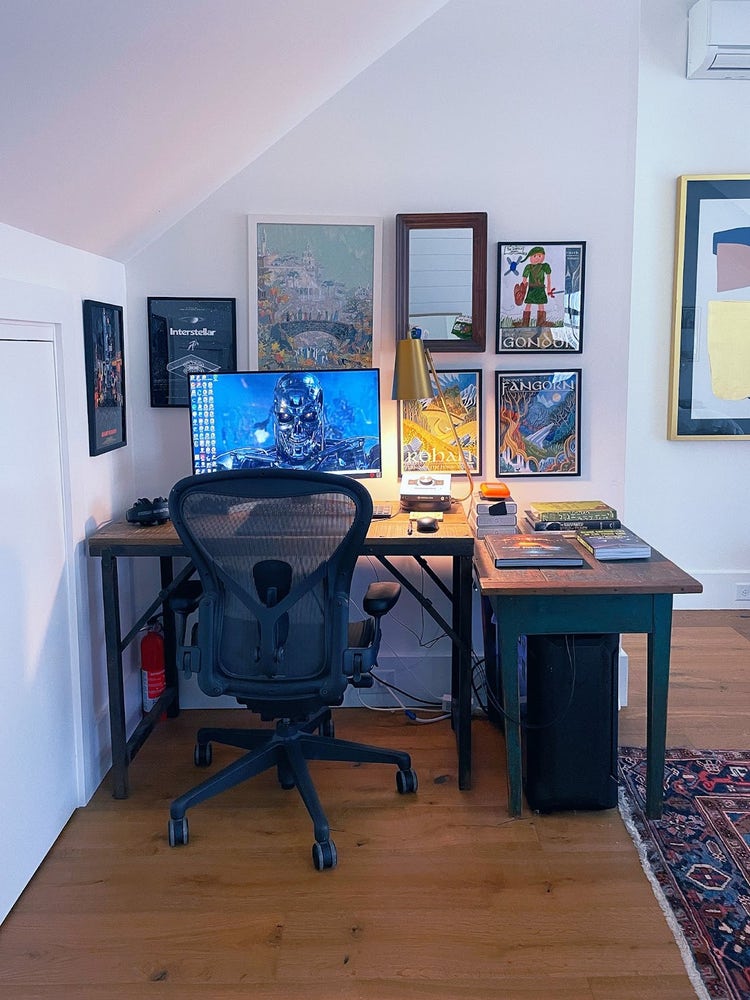
Image Source: Christian Haberkern.
Appleton: My favorite thing about my work space is all the toys in my office. I have one for everything that we’ve worked on. Whether it's a movie or not, I try to find some sort of commemorative thing. I have action figures, I have hot wheels for the cars, I have trading cards for some show we did that made trading cards. All the memorabilia I’ve collected over the years is there to remind me of everything I’ve accomplished while working here.
Herman: Same thing here! I have props and things all over my office from things we’ve done. I have tons of Loki props in my office and on my desk. At any given moment, I can grab a prop from something to remind me of our work and passion. I’ve also painted one of my walls in whiteboard paint so I can scribble and get crazy with ideas. I love to write notes and jot things down and that's a really creative and visual way to do that.
Haberkern: My favorite thing about my work space is that I'm up on a mountain and in the woods sort of isolated from everything and anyone. I can think clearly and when I walk out my front door I'm out in nature. It's replenishing in so many ways.