Behind the Scenes with Jericho, Senior Staff Security Research Scientist
Across Adobe, teams dedicated to security research play a critical role in strengthening our defenses and helping the organization stay ahead of emerging threats. These groups work behind the scenes to understand complex systems, uncover subtle signals in vast amounts of data, and build detection capabilities that help protect millions of users every day.
Curious about what it’s like to work at the intersection of machine learning, security, and large‑scale data? In this Behind the Scenes feature, we introduce Jericho Cain, Senior Staff Security Research Scientist, whose deep curiosity, scientific mindset, and passion for complex problem‑solving shape the innovative work he leads on our Security Platform and ML Engineering team.
Tell us about your career journey and background. What initially got you interested in cybersecurity?
My career began in academic research. I earned a PhD in physics and spent several years working in large-scale scientific collaborations, including work related to LIGO, followed by research at a national laboratory in acoustics and fluid mechanics. That experience shaped how I think about complex systems, uncertainty, and data, particularly in environments where signals are weak, and noise is unavoidable. Over time, I began exploring ways to apply those skills in industry, where projects tend to move faster and have more immediate real-world impact.
That transition started through conversations with a friend working in data science, which helped me see how broadly applicable quantitative and modeling skills outside academia could be. I eventually moved into a data science role where I worked across a wide range of applied problems, including graph and streaming analytics on large-scale systems. In addition to projects like baseball analytics and weather forecasting, I spent time thinking about how to process and reason over high-volume, real-time data reliably. Working close to high-performance computing gave me a firsthand view of the challenges involved in moving models from research into production at scale.
From there, I moved into healthcare, applying machine learning to highly unstructured and sensitive data. I worked on natural language processing models applied to medical charts, including BERT-based approaches used to reconstruct document structure in order to reliably extract clinical information for ICD-10 coding. In a subsequent role, I focused on using machine learning to more efficiently build medical cohorts for clinical research. These experiences reinforced how important correctness, robustness, and trust are when data-driven systems are used to support high-stakes decisions, especially when the data itself is messy, incomplete, or ambiguous.
My interest in cybersecurity grew naturally from that work. Many of the challenges felt familiar, including complex systems, incomplete information, and the need to reason under uncertainty. What stood out to me was the adversarial nature of the domain, where failure modes are often intentional rather than accidental. I became increasingly interested in how machine learning, including techniques drawn from streaming analytics and language models, could be applied to detect, understand, and respond to security threats. That curiosity ultimately led me to pursue roles focused on applying ML techniques to cybersecurity problems, where I could bring together my background in physics, data science, and applied machine learning in a field that is both technically demanding and constantly evolving.
What do you enjoy most about your current role?
As a senior staff security research scientist on the Security Platform and ML Engineering team, my work focuses on building machine learning-driven systems to help identify and prioritize potentially malicious activity. I work on models that analyze authentication logs to surface suspicious behavior, as well as prioritization systems that help teams focus on the most relevant alerts from endpoint detection tools. I’ve also helped build a detection-as-code framework that allows detection logic to be developed, tested, and iterated in a more systematic and scalable way.
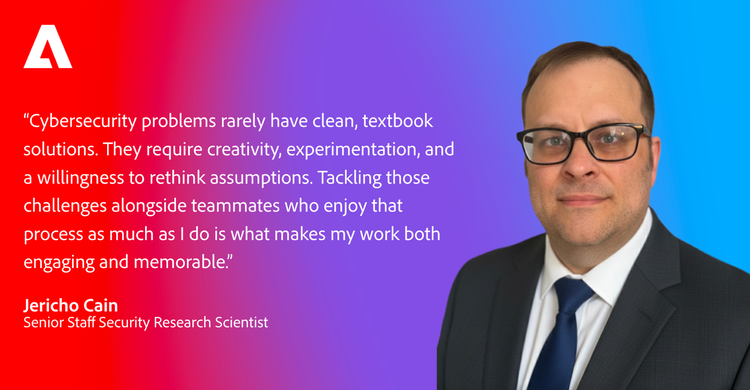
Cybersecurity problems rarely have clean, textbook solutions. They require creativity, experimentation, and a willingness to rethink assumptions. Tackling those challenges alongside teammates who enjoy that process as much as I do is what makes my work both engaging and memorable.
What is your favorite part about working at Adobe?
For me, the most meaningful part of working at Adobe is the environment it creates for doing deep, technically challenging work in a sustainable way. The work-life balance allows me to stay engaged with complex problems without burning out, which is especially important in a field like security where the challenges are ongoing and rarely simple.
I also value the level of autonomy I am given. There is room to explore ideas, prototype solutions, and iterate thoughtfully rather than rushing to predefined answers. That flexibility makes it possible to take on harder problems and approach them from first principles, which is something I genuinely enjoy.
Most importantly, I appreciate the people I work with day to day. My teammates are thoughtful, collaborative, and highly capable, and they create a culture where ideas are shared openly and technical discussions are constructive. Having that kind of local team environment within a large organization makes a big difference. It is what keeps the work interesting and makes Adobe a place where I can continue to grow and do meaningful work.
What is one piece of advice you would give to someone interested in pursuing a career in cybersecurity?
For anyone interested in applying machine learning to cybersecurity, my biggest piece of advice is to stay grounded and avoid chasing hype. The most advanced or complex model is not always the right solution. The best tool is the one that reliably solves the problem you have.
Spend time developing a deep understanding of your data before you focus on algorithms. Ask whether the data truly contains the signals you are looking for, what assumptions hold today, and which ones may change over time. In security especially, data evolves as systems change and adversaries adapt, so models that look good initially can degrade quickly if those shifts are not accounted for.
It is also important to understand the fundamentals of the techniques you use. Knowing how an algorithm works, what its limitations are, and how to measure success with the right metrics matters far more than simply applying the latest approach. Strong fundamentals and good judgment will take you much further than any single tool or framework.
Finally, what is one thing people would be surprised to know about you?
Although I no longer work as a physicist full time, I have stayed closely connected to the field. I teach a single physics course each quarter at a local college, and I continue to do research in gravitational wave astrophysics, where I apply machine learning methods to detection problems.
I currently have academic research under revision at Classical and Quantum Gravity, with additional work under peer review. Staying engaged with research gives me a chance to explore ideas more deeply and to keep one foot in the scientific community alongside my industry work.
Outside of research, I am also an avid astronomer and astrophotographer. Spending time under dark skies with a telescope is a great counterbalance to my day-to-day work, and it is one of the ways I stay connected to the physics that originally drew me into science in the first place.
jeric

Subscribe to the Security@Adobe newsletter
Don’t miss out! Get the latest Adobe security news and exclusive content delivered straight to your inbox.