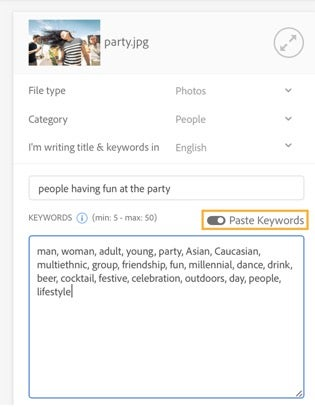
While keywording isn’t necessarily the most glamorous aspects of the stock business, it is most definitely one of the most important. You can have the best photo or video ever shot in the history of the camera, but if a customer can’t find it they can’t buy it. The way customers find your content is by searching for keywords. Below are best practices for keywording your content to help increase visibility in search.
Stock contributors: If you need deeper help with using keywords for findability of your images on Adobe Stock, check out this resource on Adobe HelpX.
Adobe Stock’s search engine puts an emphasis on keywords based on the order you add them. The most important keyword should be listed first, followed by the second most important, and so on. The first 10 keywords are the most critical.
The contributor portal will suggest up to 25 keywords automatically for each submission. Review them for accuracy, reorder or remove irrelevant words, and add any keywords that you think the tool has missed.
If you upload files with keywords already embedded in the metadata, the auto-keywords feature is disabled.
If you prefer to add your own keywords from scratch, you can copy and paste keywords separated by commas, or upload a CSV file. You can add your keywords to the metadata using Adobe Bridge or Lightroom, and the Adobe Stock Contributor Portal will automatically add them to your file. It is important to note that Lightroom with alphabetize your keywords so if you use LR, be sure to rearrange the keywords once in the portal in order of importance.
General keywording tips
The minimum keyword amount is five, the maximum is 50. The sweet spot is generally between 15-25. It’s more important to be accurate and relevant than to fill up all 50 slots. Only add relevant keywords that apply to your content specifically.
Titles are not searchable in Adobe Stock. If a word is important enough to add to your title, add it as a keyword as well.
Use singular nouns, plural variations will automatically be applicable.
Use verbs — describe the actions in the infinitive form (ex. run, jump, sing, smile).
After describing the basic elements and actions, add conceptual keywords that describe the feelings, mood, or trends (e.g., solitude, childhood, milestones, celebration).
Do not use brand or trademarked names (Porsche, iPad), camera specifications (Nikon, 12MP), or people’s names.
Do not spam keywords — irrelevant keywords can actually hurt your visibility on the Stock site.
For additional info on how to optimize your keywords, visit our Learn page.
Conclusion
Ready to start selling your photos, videos, illustrations, and more? Submit them to the Adobe Stock Contributor Portal and get your work out in front of millions of buyers.

Adobe Stock is making video more accessible and affordable
Adobe Stock is making video easier for everyone to access and afford. We’re adding HD video to most multi-asset plans — with no increase in plan pricing. Adobe Stock is the best choice for creators who want to lower costs, save time, and simplify licensing.
Healing Reflections: Holding up a Mirror to Everyday Wellness
Concepts of health, wellness, and healing are perennial themes within visual branding, and they are enjoying a particular renaissance today, as the world collectively faces public health crises that have made self-care more than just a buzzword or a beauty trend.
How Adobe Stock is embracing diverse and inclusive imagery as consumers seek authenticity
How Adobe Stock is expanding its collection to provide imagery and video that are diverse and inclusive
06-30-2021
Title
Adobe Stock keywording cheat sheet
Description
Adobe Stock automatically generates keywords for your content, unless your file already contains keywords. The order of keywords matters, so go ahead and drag the number to the left of a keyword up or down to rearrange the order. To remove a keyword, hover over it and click the X to delete it.
You can control how Adobe websites use cookies and similar technologies by making choices below. But note that if you disable cookies and similar technologies entirely, Adobe websites may not function properly.
Cookies are small text files stored by your web browser when you use websites. There are also other technologies that can be used for similar purposes like HTML5 Local Storage and local shared objects, web beacons, and embedded scripts. These technologies help us do things like remembering you and your preferences when you return to our sites, measure how you use the website, conduct market research, and gather information about the ads you see and interact with.
You can make choices in the menu below about what cookies and other technologies you want us to use on Adobe sites when you visit them from this browser. You can always change those choices later by clicking on the Cookie Preferences link at the bottom of the page.
If enabled:
We can improve your experience by tailoring the site and the content to things we think might be of interest
We can better keep track of your preferences — like what language you prefer to use
We will better understand your likely interests so we can provide you more relevant Adobe ads and content on non-Adobe websites and in non-Adobe apps
It will help us improve the performance of our website and those of our partners who use the Adobe Experience Cloud
If disabled:
We won’t be able to remember you from session to session so the experience may not be tailored to your interests
You’ll still have access to the content of the site but certain features that depend on cookies may not function
You’ll still see ads, they just may not be as relevant to you
General information
You can control how Adobe websites use cookies and similar technologies by making choices below. But note that if you disable cookies and similar technologies entirely, Adobe websites may not function properly.
Cookies are small text files stored by your web browser when you use websites. There are also other technologies that can be used for similar purposes like HTML5 Local Storage, web beacons, and embedded scripts. These technologies help us do things like remembering you and your preferences when you return to our sites, measure how you use the website, conduct market research, and gather information about the ads you see and interact with.
You can make choices in the menu below about what cookies and other technologies you want us to use on Adobe sites when you visit them from this browser. You can always change those choices later by clicking on the Cookie Preferences link at the bottom of the page.
If enabled:
We can improve your experience by tailoring the site and the content to things we think might be of interest
We can better keep track of your preferences — like what language you prefer to use
We will better understand your likely interests so we can provide you more relevant Adobe ads and content on non-Adobe websites and in non-Adobe apps
It will help us improve the performance of our website and those of our partners who use the Adobe Experience Cloud
If disabled:
We won’t be able to remember you from session to session so the experience may not be tailored to your interests
We’ll still count your use of our site and services
You’ll still have access to the content of the site but certain features that depend on cookies may not function
You’ll still see ads, they just may not be as relevant to you
Operate the site and core servicesOperate site and measure engagement
Always active
These cookies are required, and they are used to enable the site and related services core functionality. Without them the site could not operate, so they cannot be disabled.
These cookies enable the site and related services’ core functionality and collect statistics about user engagement, such as counting active use to help us understand trends. These cookies cannot be disabled.
Measure performance
These cookies are used to analyze site usage to measure and improve performance. Without them Adobe cannot know what content is most valued and how often unique visitors return to the site, making it hard to improve information we offer to you.
These cookies are used to analyze site usage to measure and improve performance. Without them Adobe cannot know what content is most valued, making it hard to improve information we offer to you.
Extend functionality
These cookies are used to enhance the functionality of Adobe sites such as remembering your settings and preferences to deliver a personalized experience; for example, your username, your repeated visits, preferred language, your country, or any other saved preference.
Personalize advertising
These cookies are used to enable Adobe and our partners to serve ads more relevant to your interests. Without them you will still see ads, but they might not be as relevant to you.