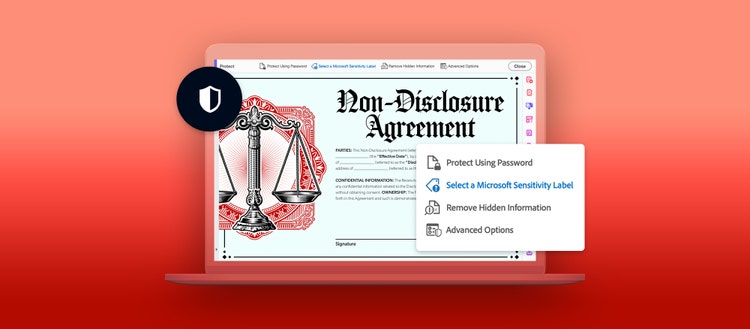
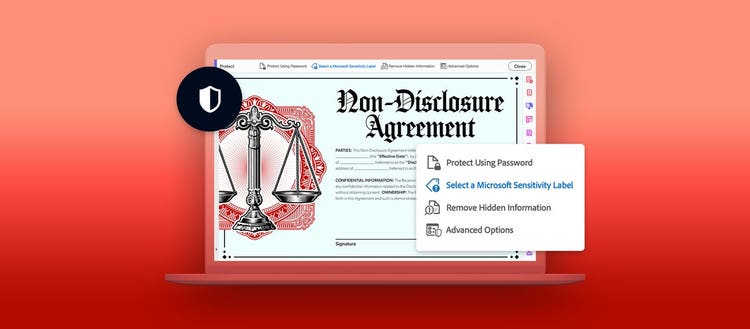
MPIP labeling is now available under the Protect tool.
PDF is the world’s most popular business document format. Organizations demand best-in-class security, compliance, and information protection to ensure only critical stakeholders can view, manage, and approve high-value business documents such as PDFs. With the increasing need for security for digital assets, we see Microsoft Purview Information Protection (MPIP) in Adobe Acrobat as fundamental and game-changing for organizations. Information Protection already classifies and protects Word documents, Excel spreadsheets, and PowerPoint presentations. This integration brings the same classification, labeling and protection already available in Office file formats to PDFs via Acrobat.
Adobe Acrobat
Stay connected to your team with simple workflows across desktop, mobile, and web — no matter where you’re working.
Earlier in the year, at Microsoft Build, Adobe announced Information Protection labeling in Acrobat as a new capability for end users.
Adobe Acrobat and Reader apps started supporting consistent viewing of PDFs protected by Microsoft Purview Information Protection in 2018. For organizations standardizing on MPIP, we have now launched the native capability to apply and edit Information Protection sensitivity labels and policies to their PDFs within the desktop version of Acrobat. This latest and comprehensive MPIP labeling experience leverages the most recent MPIP SDK version. We have also considered finer nuances such as label descriptions, embedded content markings, justification logic, etc. to ensure a more intuitive experience for our customers.
In addition to manual pre-defined labels, Acrobat also supports advanced use cases of default labeling, mandatory labeling, and user-defined permissions for bespoke access.
We partnered closely with many customers including an independent agency of the US government that plans on leveraging sensitivity labels to protect confidential information in financial forms shared as PDFs. Additionally, a major sports apparel manufacturer requires assigning bespoke permissions to users on a varied set of important and sensitive PDF documents. We also spoke to a leading global investment management company where relationship managers want to protect Personally Identifiable Information (PII) and highly confidential client data in documents such as client reports and account statements. They also expressed advanced labeling needs to implement default and mandatory labeling for PDFs.
We are excited to see customers using this native integration of Information Protection labelling in Adobe Acrobat for many purposes. It is well suited for regulated industries such as government sector, healthcare, and financial services, and is especially valuable in departments such as legal, finance, and procurement.
We are currently launching the feature on the desktop app and have plans to support MPIP use cases for PDFs (viewing, labeling, persisting protection during export workflows) for mobile and web surfaces in the future.
Adobe has been named the Security ISV of the Year for 2023 by Microsoft. Microsoft announced the 2023 Microsoft Security Excellence Awards winners at the annual RSA conference in San Francisco. PDFs are the secure document format and often contain sensitive information. Adobe is committed to providing data protection capabilities to fully support the PDF file format, and is working to achieve this across multiple products, services, and platforms. This award recognizes the innovation and investment Adobe has made in ensuring security & compliance as illustrated by the support for Microsoft Purview Information Protection sensitivity labels in Acrobat.
Learn more about how Adobe and Microsoft are transforming the future of work here.
We would like to thank Jatin Sethi, product manager, for his contributions to this blog post.
Recommended for you
Adobe adds new Acrobat tools to tackle PDF tasks in the browser
If you’re juggling digital documents, Adobe has a solution. Acrobat web is a simple way to tackle a plethora of PDF tasks in your browser.
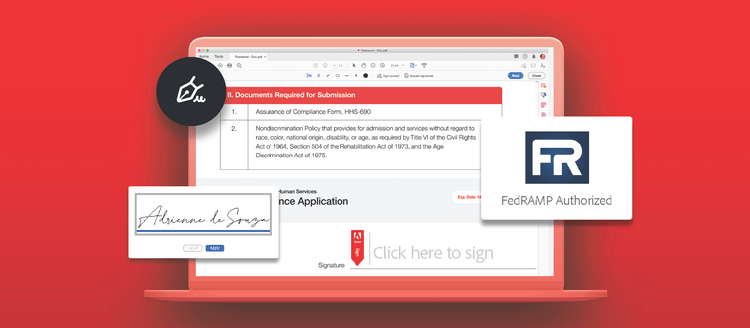
Adobe Acrobat Sign for Government, a FedRAMP Moderate authorized solution, gives government departments and agencies a new, security-enhanced tool for digital document workflows and electronic signatures.
08-17-2022
Title
Introducing Microsoft Purview Information Protection (MPIP) in Acrobat
Description
Microsoft Purview Information Protection (MPIP) in Adobe Acrobat brings classification, labeling and protection to PDFs via Acrobat.
You can control how Adobe websites use cookies and similar technologies by making choices below. But note that if you disable cookies and similar technologies entirely, Adobe websites may not function properly.
Cookies are small text files stored by your web browser when you use websites. There are also other technologies that can be used for similar purposes like HTML5 Local Storage and local shared objects, web beacons, and embedded scripts. These technologies help us do things like remembering you and your preferences when you return to our sites, measure how you use the website, conduct market research, and gather information about the ads you see and interact with.
You can make choices in the menu below about what cookies and other technologies you want us to use on Adobe sites when you visit them from this browser. You can always change those choices later by clicking on the Cookie Preferences link at the bottom of the page.
If enabled:
We can improve your experience by tailoring the site and the content to things we think might be of interest
We can better keep track of your preferences — like what language you prefer to use
We will better understand your likely interests so we can provide you more relevant Adobe ads and content on non-Adobe websites and in non-Adobe apps
It will help us improve the performance of our website and those of our partners who use the Adobe Experience Cloud
If disabled:
We won’t be able to remember you from session to session so the experience may not be tailored to your interests
You’ll still have access to the content of the site but certain features that depend on cookies may not function
You’ll still see ads, they just may not be as relevant to you
General information
You can control how Adobe websites use cookies and similar technologies by making choices below. But note that if you disable cookies and similar technologies entirely, Adobe websites may not function properly.
Cookies are small text files stored by your web browser when you use websites. There are also other technologies that can be used for similar purposes like HTML5 Local Storage, web beacons, and embedded scripts. These technologies help us do things like remembering you and your preferences when you return to our sites, measure how you use the website, conduct market research, and gather information about the ads you see and interact with.
You can make choices in the menu below about what cookies and other technologies you want us to use on Adobe sites when you visit them from this browser. You can always change those choices later by clicking on the Cookie Preferences link at the bottom of the page.
If enabled:
We can improve your experience by tailoring the site and the content to things we think might be of interest
We can better keep track of your preferences — like what language you prefer to use
We will better understand your likely interests so we can provide you more relevant Adobe ads and content on non-Adobe websites and in non-Adobe apps
It will help us improve the performance of our website and those of our partners who use the Adobe Experience Cloud
If disabled:
We won’t be able to remember you from session to session so the experience may not be tailored to your interests
We’ll still count your use of our site and services
You’ll still have access to the content of the site but certain features that depend on cookies may not function
You’ll still see ads, they just may not be as relevant to you
Operate the site and core servicesOperate site and measure engagement
Always active
These cookies are required, and they are used to enable the site and related services core functionality. Without them the site could not operate, so they cannot be disabled.
These cookies enable the site and related services’ core functionality and collect statistics about user engagement, such as counting active use to help us understand trends. These cookies cannot be disabled.
Measure performance
These cookies are used to analyze site usage to measure and improve performance. Without them Adobe cannot know what content is most valued and how often unique visitors return to the site, making it hard to improve information we offer to you.
These cookies are used to analyze site usage to measure and improve performance. Without them Adobe cannot know what content is most valued, making it hard to improve information we offer to you.
Extend functionality
These cookies are used to enhance the functionality of Adobe sites such as remembering your settings and preferences to deliver a personalized experience; for example, your username, your repeated visits, preferred language, your country, or any other saved preference.
Personalize advertising
These cookies are used to enable Adobe and our partners to serve ads more relevant to your interests. Without them you will still see ads, but they might not be as relevant to you.