August has been an exhilarating month for Substance 3D, featuring a new release of Substance 3D Designer, impressive applications of Substance in game design, and notable innovations and collaborations showcased at SIGGRAPH 2024.
Getting creative with designer’s new nodes
The latest version of Designer introduces a variety of new image and color manipulation nodes, along with overall quality improvements, to enhance material creation and streamline workflows.
New color nodes allow precise manipulation of input color palettes and custom palette creation
The Kuwahara Filter node enables unique painting stylization
Various technical nodes improve texture accuracy and performance.
Learn more about the new features and updates to Designer.
Bringing environments to life in Alan Wake 2

Creating AAA games requires an ever-increasing number of high-quality assets for complex environments.
Thanks to Substance 3D Designer, in-house tools and technical implementations, the art team at Remedy Entertainment was able to generate vast environments, streamline their material creation workflow, and maintain top-notch asset quality throughout production.
Read the interview with Principal Technical Environment artist, Benjamin Lindquist, who shares more about the studio’s content creation pipeline for Alan Wake 2.
SIGGRAPH 2024: Showcasing Substance 3D innovation and collaboration
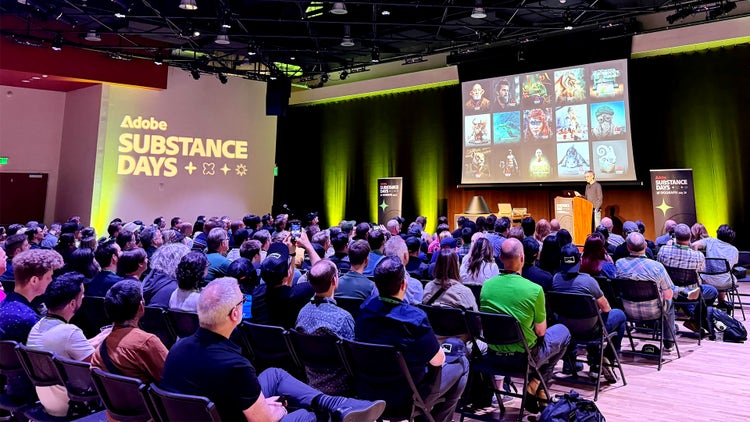
The Substance Days event brought together researchers, users, and partners, establishing a hub of creativity. Highlights were the keynote during which Sébastien Deguy celebrated the 10th anniversary of Substance Painter, and Guido Quaroni outlined the vision for USD and automation. The public presentation of the HP Z CAPTIS material scanner by Josh St. John and Jérôme Derel, the result of a long-standing partnership with HP, was a proud moment. Additionally, the selection of research papers curated by Tamy Boubekeur was truly mind-blowing.
SIGGRAPH concluded with inspiring encounters and exchanges, showcasing a vibrant community of innovation, exploration, and the fusion of art and science.
Substance 3D at IBC 2024

At IBC 2024, we invite you to explore the powerful capabilities of Substance 3D for creating stunning 3D motion design content. Our showcase will demonstrate how Substance 3D excels in producing detailed, photorealistic materials and best-in-class texturing. These features make it an ideal tool for enhancing 3D composites, creating lifelike product visualizations, and elevating motion design projects to new heights. With the ability to bring your designs to Adobe After Effects and Cinema 4D, Substance 3D puts more creativity and control at your fingertips.
Visit us at the Adobe booth to see Substance 3D in action and learn how it can transform your workflow — Hall 7, Stand #7.B35 — Meet our artists who will showcase the tools and workflows and discover how Substance 3D can help you deliver visually stunning projects.
How ZDF Digital is using Substance 3D to deliver immersive experiences
The Digital Production team at ZDF Digital embraces 3D visuals in many of its projects, whether creating realistic virtual spaces for films or developing virtual and augmented reality experiences. With Adobe Substance 3D, the team balances production speed with the quality visuals and fully-textured environments that audiences expect from ZDF.
08-19-2024
Celebrating 10 years of Substance 3D Painter: A journey of innovation and creativity
Substance 3D Painter celebrates its 10th anniversary, marking a decade of revolutionizing texturing and material workflows and the release of its milestone 10.0 version.
08-05-2024
Painter 10th Anniversary and Generative AI Updates for Substance 3D
We focus on streamlining workflows, boosting productivity, and showcasing the latest creative tools and features in Adobe Substance 3D. From new integrations to AI-powered capabilities.
05-29-2024
Cookie Settings
General information
You can control how Adobe websites use cookies and similar technologies by making choices below. But note that if you disable cookies and similar technologies entirely, Adobe websites may not function properly.
Cookies are small text files stored by your web browser when you use websites. There are also other technologies that can be used for similar purposes like HTML5 Local Storage and local shared objects, web beacons, and embedded scripts. These technologies help us do things like remembering you and your preferences when you return to our sites, measure how you use the website, conduct market research, and gather information about the ads you see and interact with.
You can make choices in the menu below about what cookies and other technologies you want us to use on Adobe sites when you visit them from this browser. You can always change those choices later by clicking on the Cookie Preferences link at the bottom of the page.
If enabled:
We can improve your experience by tailoring the site and the content to things we think might be of interest
We can better keep track of your preferences — like what language you prefer to use
We will better understand your likely interests so we can provide you more relevant Adobe ads and content on non-Adobe websites and in non-Adobe apps
It will help us improve the performance of our website and those of our partners who use the Adobe Experience Cloud
If disabled:
We won’t be able to remember you from session to session so the experience may not be tailored to your interests
You’ll still have access to the content of the site but certain features that depend on cookies may not function
You’ll still see ads, they just may not be as relevant to you
General information
You can control how Adobe websites use cookies and similar technologies by making choices below. But note that if you disable cookies and similar technologies entirely, Adobe websites may not function properly.
Cookies are small text files stored by your web browser when you use websites. There are also other technologies that can be used for similar purposes like HTML5 Local Storage, web beacons, and embedded scripts. These technologies help us do things like remembering you and your preferences when you return to our sites, measure how you use the website, conduct market research, and gather information about the ads you see and interact with.
You can make choices in the menu below about what cookies and other technologies you want us to use on Adobe sites when you visit them from this browser. You can always change those choices later by clicking on the Cookie Preferences link at the bottom of the page.
If enabled:
We can improve your experience by tailoring the site and the content to things we think might be of interest
We can better keep track of your preferences — like what language you prefer to use
We will better understand your likely interests so we can provide you more relevant Adobe ads and content on non-Adobe websites and in non-Adobe apps
It will help us improve the performance of our website and those of our partners who use the Adobe Experience Cloud
If disabled:
We won’t be able to remember you from session to session so the experience may not be tailored to your interests
We’ll still count your use of our site and services
You’ll still have access to the content of the site but certain features that depend on cookies may not function
You’ll still see ads, they just may not be as relevant to you
Operate the site and core servicesOperate site and measure engagement
Always active
These cookies are required, and they are used to enable the site and related services core functionality. Without them the site could not operate, so they cannot be disabled.
These cookies enable the site and related services’ core functionality and collect statistics about user engagement, such as counting active use to help us understand trends. These cookies cannot be disabled.
Measure performance
These cookies are used to analyze site usage to measure and improve performance. Without them Adobe cannot know what content is most valued and how often unique visitors return to the site, making it hard to improve information we offer to you.
These cookies are used to analyze site usage to measure and improve performance. Without them Adobe cannot know what content is most valued, making it hard to improve information we offer to you.
Extend functionality
These cookies are used to enhance the functionality of Adobe sites such as remembering your settings and preferences to deliver a personalized experience; for example, your username, your repeated visits, preferred language, your country, or any other saved preference.
Personalize advertising
These cookies are used to enable Adobe and our partners to serve ads more relevant to your interests. Without them you will still see ads, but they might not be as relevant to you.