Built for bravery
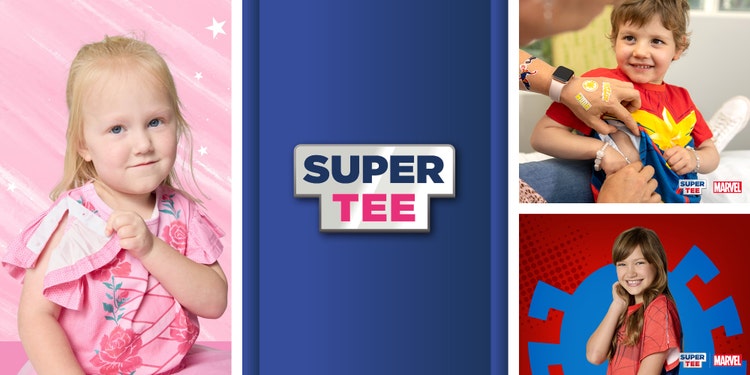
Not all superheroes wear capes. Some wear a Supertee, a medical garment disguised as a superhero costume that makes hospital stays more comfortable and lifts the spirits of children who are often in the toughest fight of their lives.
Since its launch in 2018, Supertee has empowered thousands of young patients in hospitals across Australia and the world. With creative support from Adobe — providing tools for everything from garment patterns to promotional videos — the initiative continues to grow, forging new partnerships and expanding its mission to uplift and inspire.
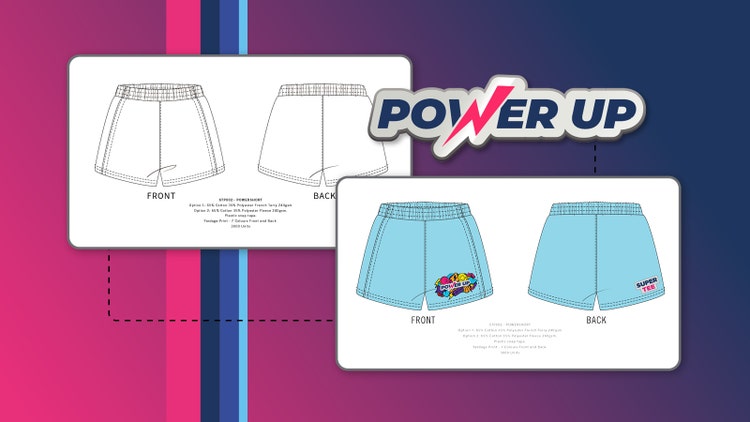
Supertees feature plastic snap closures. “They work like Lego bricks, for greater convenience while changing or accessing medical lines,” says Jason Sotiris, Co-founder and CEO of Supertee. As the charity’s flagship garment reached more children around the world, its creators saw new opportunities to boost its impact within hospital settings. The latest innovation in the works is a series of four new products, called Power Ups, to enhance functionality and the Supertee wearing experience.
But product innovation is only half the battle. The new products needed an identity that children would love, that parents could trust and that hospitals would welcome. To fuel the design, Adobe — already supporting Supertee with grants, software, employee volunteer time and strategic planning input —connected the charity with Torrens University Australia, an Adobe Creative Campus.
The university’s Billy Blue College of Design engaged with Supertee via a live client brief for its Work Integrated Learning (WIL) subject, offered within the Diploma of Graphic Design. The subject enables students to tackle real-world client briefs within the classroom, in a major project run over 12 weeks.
The creative crucible
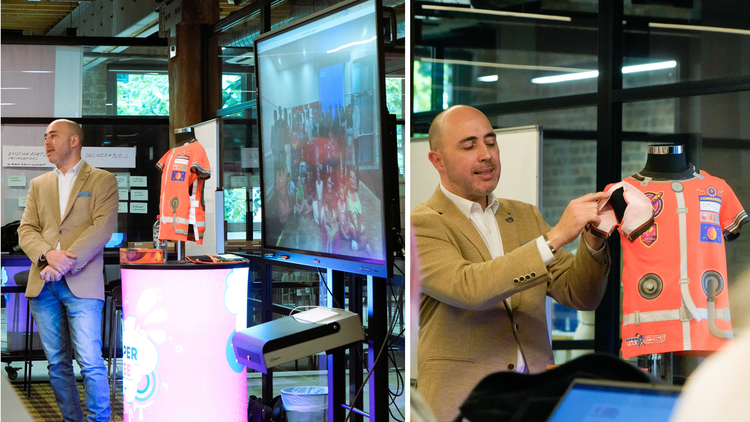
When Sotiris shared his story with a classroom of nine design students, the atmosphere shifted. “It was a very emotional briefing. Afterwards, the room went quiet,” says Caro Hunt, Senior Learning Facilitator at Torrens University’s Billy Blue College of Design. “The students understood instantly that this was about more than design. They could make a real difference.”
Armed with Adobe Creative Cloud, the students rose to the occasion. Although each student worked on their own submission, they collaborated creatively, brainstorming and sharing ideas and feedback — refining sketches, debating colours and testing concepts against the unique demands of hospital environments. Every decision balanced child appeal with medical practicality, while recognising that the children wearing these garments may be in the middle of an exhausting battle.
The WIL process gave students structured client touchpoints, including an initial briefing, a mid-project feedback session and a final presentation. This format mirrors professional practice, helping students learn how to navigate evolving feedback and adapt to a client’s needs.
Graffiti sparks a design revolution
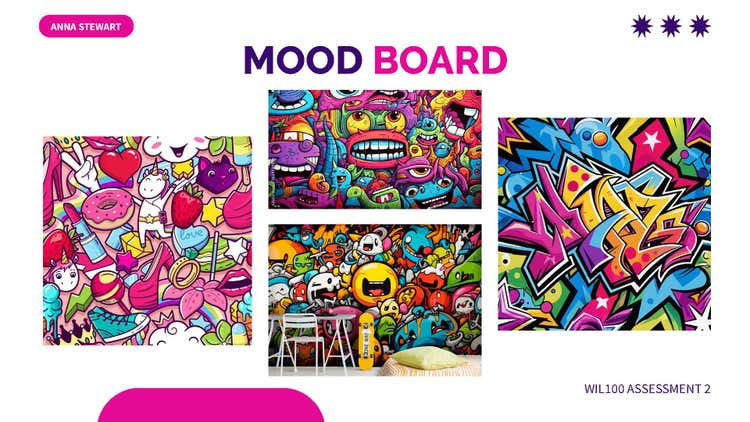
Among the students working on the brief, Anna Stewart, then completing her Diploma of Graphic Design. In his initial presentation, Sotiris talked about brands that have mastered the art of making practical things feel like treasures for kids, the kind you find in bright, colourful stores that spark imagination. Those ideas helped Supertee think differently about how medical accessories could feel and led Stewart to imagine graffiti as the visual language that could tie together power, play and resilience.
For the final presentation, each student created three Instagram tiles, an actual product design and two collateral items. Stewart used Adobe Fresco to achieve a loose, hand-drawn effect with her graffiti sketches, which were then finalised in Adobe Illustrator for the product design and collateral stickers. An Adobe Stock template gave Stewart the foundation to mock up her second collateral item — a sponsor appreciation card to include with each Power Up.
For the Instagram tiles, Stewart took advantage of pre-sized templates in Adobe Express, which staff at Supertee also use to create social content. Moodboards, as well as her final presentation, came together in Adobe InDesign, which also made it easy to package and deliver all final files.
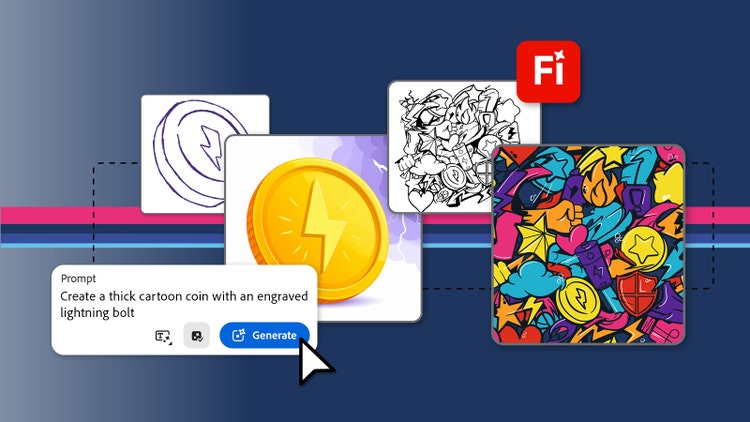
To ensure her designs hit the mark while remaining commercially safe, Stewart used Adobe Firefly. “I have aphantasia, which means I can’t form mental images,” she explains. “Firefly lets me generate exactly what I imagine in words but can’t picture. For example, I used Firefly to help me visualise a thick cartoon coin that I used as the inspiration for my original artwork.”
Stewart’s final concept featured tagging-style icons with bold, gritty colours that communicated courage. “Her design conveyed strength and toughness, while keeping it fun,” says Sotiris. “It hit the brief in a way I hadn’t imagined.”
As a result, Supertee hired Stewart to develop the concept further, create prototypes and design collateral to help launch the Power Ups into hospitals, where they will become part of the armour for children in long-term treatment.
Purpose as a design superpower
For Kate Mork, Senior Learning Facilitator at Torrens University’s Billy Blue College of Design, the project demonstrates the essence of impactful design. “This wasn’t theoretical,” she says. “Students saw the impact their designs could have on real children and families. It’s human-centred design in action.”
That impact works in both directions. “Every Supertee design is its own universe,” says Sotiris. “This partnership helps us create more worlds for kids to choose from. Having Torrens University and Adobe in our corner is helping us scale the mountain, and the view from the top will be beautiful.”
The sequel is already in motion: the Power Ups are scheduled for launch in 2026, with support from Rise & Shine Education and Brother International Australia. Stewart continues to design product graphics and marketing visuals, while Torrens University is preparing to involve students from photography and fashion to support future Supertee initiatives.
“We’re a family charity supported by families, helping other families,” says Sotiris. “The potential is huge and we’re only getting started.”