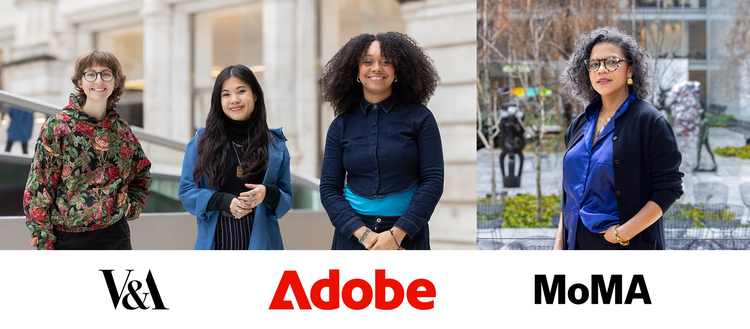
Creativity is a powerful force for connection, learning, and change. For the next generation of creators to expand creativity, they need access to the platforms, mentorship, and resources that help their ideas take shape and help them further their craft. The Adobe Creative Residency program exists to help provide that access. The continuing collaboration between the Adobe Foundation and world-class cultural institutions provides expanded opportunities for emerging creators around the globe.
The Creative Residency program today partners with institutions including The Museum of Modern Art (MoMA) in New York and the Victoria and Albert Museum (V&A) in London, with the goal of supporting artists whose work engages communities, explores new modes of expression, and makes creativity more accessible. Recently, the program has also debuted at the Museum of Art & Photography in Bangalore, the National Museum of Art Japan, and the Museum of Image and Sound (MIS) in São Paulo.
Today, we’re proud to welcome our 2026 Adobe Creative Residents and celebrate the impact of the program across disciplines, geographies, and audiences.
Adobe x MoMA
Adobe’s partnership with MoMA continues to deepen the museum’s engagement with young people, educators, and local communities across New York City. Through the Creative Residency program, MoMA has expanded opportunities for artists to work alongside curators, educators, and community partners, using the museum’s collections and archives as a foundation for socially engaged creative practice.
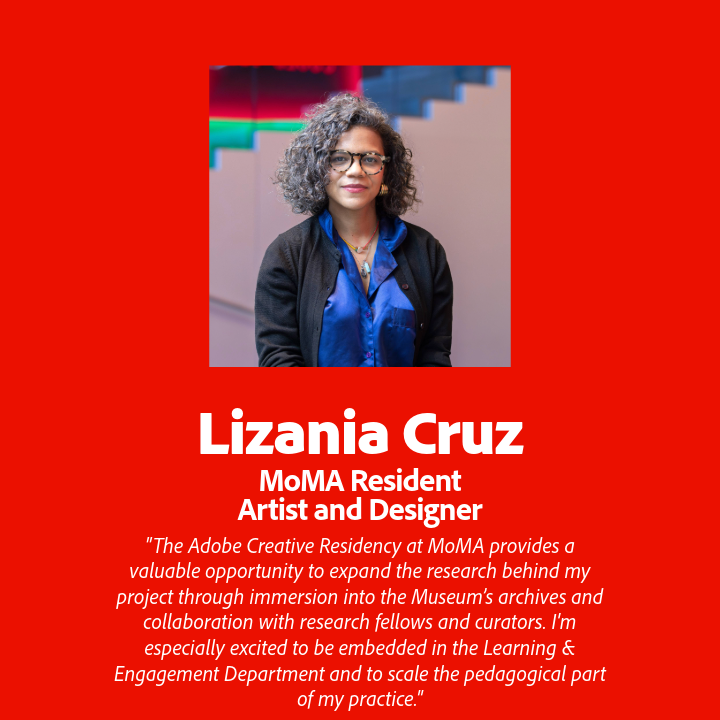
In 2026, MoMA welcomes Lizania Cruz as its Adobe Creative Resident. Cruz is a Dominican participatory artist and designer whose work explores how migration shapes ways of being, belonging and remembering. Through research, oral history and audience engagement, Cruz creates projects that surface plural narratives around migration and identity. Her work has been exhibited nationally and internationally, and she is a recipient of the 2023 New York City Artadia Award.
"Lizania joins a growing cohort of innovative and inventive resident artists. We can't wait to watch how her practice evolves during her time at MoMA and look forward to inviting New Yorkers into the Museum through her work."
—Nisa Mackie, The Edward John Noble Foundation Deputy Director of Learning and Engagement
For her residency at MoMA, Cruz will develop *Geography of Life*, a research-based, site-specific project that is both an installation and educational programming. The work examines interdependencies between humans and nature — particularly within the context of climate change and migration — through collaboration with New York City community members, including young people, educators, scientists, and community garden stewards. Rooted in Cruz’s long-standing commitment to collaboration, the project will incorporate participatory methods such as story circles, mapping sessions, and immersive installations, centering lived experience as a source of knowledge and creative material. By weaving together ecological, historical and social narratives, *Geography of Life* will invite audiences to reflect on how environmental change, public health and collective memory intersect in urban life.
Adobe x V&A
At the V&A, the Adobe Creative Residency program continues to play a vital role in expanding access to creative learning — particularly for schools, families, and young people from historically underserved communities. In recent years, Creative Residents have contributed to the growth of the V&A’s public learning programs, supporting a more inclusive and participatory approach to creativity across the museum.
In 2026, the V&A will welcome three new Adobe Creative Residents whose practices span sculpture, ceramics, and creative technology.
“The V&A Adobe Creative Residency Programme is a vital catalyst for contemporary makers and creatives, offering a unique opportunity to deepen their practice through public participation and meaningful engagement with our world-class collections. It remains a crucial cornerstone in delivering the V&A’s mission to champion design and creativity in all its forms, for everyone.”
— Dr. Helen Charman FRSA, Director of Learning, National Programs and Young V&A.
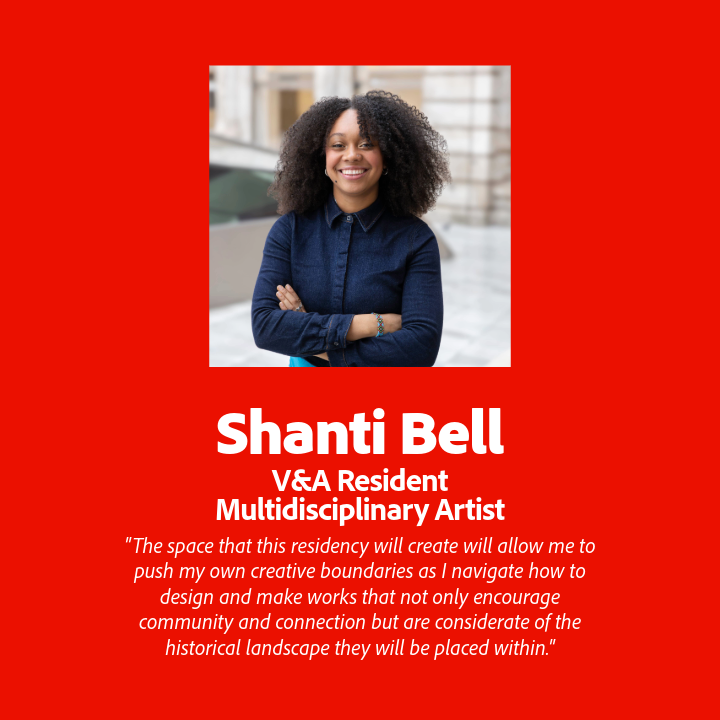
Shanti Bell is a London-based multidisciplinary artist and maker whose experiential sculptures explore the relationship between the human body, furniture and shared space. Working primarily with wood and fabric, Bell creates interactive and wearable works that invite touch, movement, and emotional connection.
During her residency, Bell will explore how furniture can act as a gateway to breaking down barriers within gallery spaces — encouraging participation, play, and collaboration among young people. Drawing from the V&A’s collections and engaging directly with youth audiences, Bell will reimagine with her work how objects can foster connection, reflection and a sense of belonging.
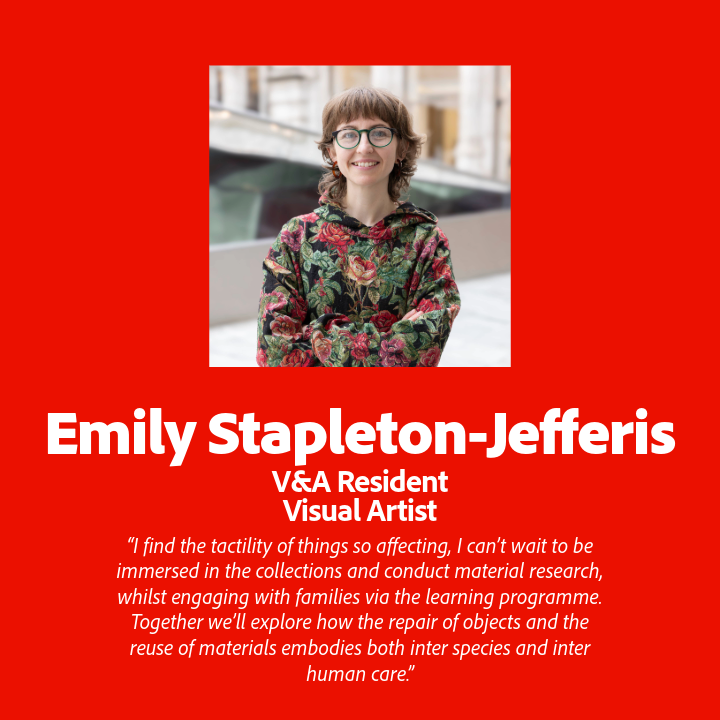
Emily Stapleton-Jefferis works between drawing and making, with a practice grounded in ceramics and an interest in care, repair and transformation of materials. Inspired by botanical, geological and human forms, her work draws attention to the beauty and strangeness of the often-overlooked natural world.
As a Creative Resident, Stapleton-Jefferis will explore themes of mending and material “liveliness,” using broken and discarded objects as a starting point for collective making with families. Through hands-on workshops and storytelling, her residency will examine repair as both a practical and poetic act — one that connects people, objects, and environments.
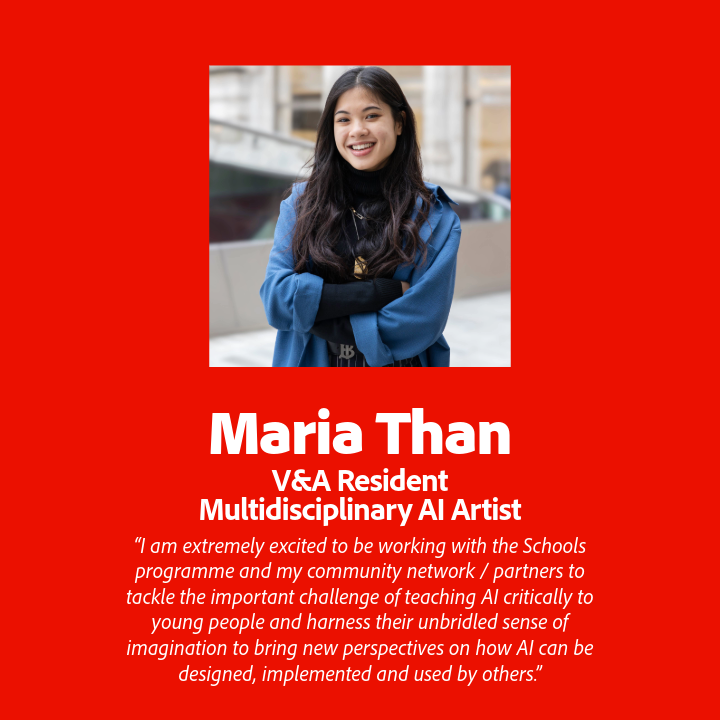
Maria Than is a multidisciplinary artist, creative technologist, and educator working in augmented reality, illustration, moving image, and creative AI. Her work explores fragmented identities, intergenerational trauma, spirituality and ethics in emerging technologies.
During her residency at the V&A, Than will collaborate with school audiences to explore creative AI as a tool for storytelling, self-expression and social good. Drawing on her experience as a lecturer and activist, she will develop accessible, values-driven approaches to digital creativity — helping young people navigate and shape the future of technology through art.
Adobe Creative Residency program
The Adobe Creative Residency program aims to reach 10 million young creators and students by 2028, supporting artists across disciplines — from visual arts and ceramics to digital media and creative technology. By partnering with leading cultural institutions and investing in community-centered creative practice, the program works to make art, education, and creative expression more accessible to all.
Learn more about the Adobe Creative Residency program and the Adobe x Museums initiative here.
Recommended for you
Introducing the Adobe Creative Collective: Shaping the next era of creative work together
Introducing the Adobe Creative Collective, elevating conversations shaping the future of creativity.
02-03-2026
Higher education & AI: Adobe’s strategy to innovate and lead
With the rapid adoption of AI in higher education, how educators teach and students learn is changing remarkably. Adobe is intent on helping the higher education community navigate the current AI crossroads.
02-02-2026
Create with unlimited generations in Adobe Firefly, the all-in-one creative AI studio
Adobe Firefly subscribers can now create unlimited generations with industry-leading image models, including Google Nano Banana Pro, GPT Image Generation, Runway Gen-4 Image, as well as Adobe's commercially safe Firefly image and video models -- sign up before March 16.
02-02-2026
Title
Adobe Creative Residency: Expanding opportunity for the next generation of creators
Description
Adobe’s 2026 Creative Residency cohort, partnering with MoMA and V&A to expand access, mentorship, and creative technology for emerging global artists and young creators.
Details
Adobe Life
CardDate
2026-02-25
CardImage
CardImageAltText
Images of Adobe’s 2026 Creative Residency artists.
You can control how Adobe websites use cookies and similar technologies by making choices below. But note that if you disable cookies and similar technologies entirely, Adobe websites may not function properly.
Cookies are small text files stored by your web browser when you use websites. There are also other technologies that can be used for similar purposes like HTML5 Local Storage and local shared objects, web beacons, and embedded scripts. These technologies help us do things like remembering you and your preferences when you return to our sites, measure how you use the website, conduct market research, and gather information about the ads you see and interact with.
You can make choices in the menu below about what cookies and other technologies you want us to use on Adobe sites when you visit them from this browser. You can always change those choices later by clicking on the Cookie Preferences link at the bottom of the page.
If enabled:
We can improve your experience by tailoring the site and the content to things we think might be of interest
We can better keep track of your preferences — like what language you prefer to use
We will better understand your likely interests so we can provide you more relevant Adobe ads and content on non-Adobe websites and in non-Adobe apps
It will help us improve the performance of our website and those of our partners who use the Adobe Experience Cloud
If disabled:
We won’t be able to remember you from session to session so the experience may not be tailored to your interests
You’ll still have access to the content of the site but certain features that depend on cookies may not function
You’ll still see ads, they just may not be as relevant to you
General information
You can control how Adobe websites use cookies and similar technologies by making choices below. But note that if you disable cookies and similar technologies entirely, Adobe websites may not function properly.
Cookies are small text files stored by your web browser when you use websites. There are also other technologies that can be used for similar purposes like HTML5 Local Storage, web beacons, and embedded scripts. These technologies help us do things like remembering you and your preferences when you return to our sites, measure how you use the website, conduct market research, and gather information about the ads you see and interact with.
You can make choices in the menu below about what cookies and other technologies you want us to use on Adobe sites when you visit them from this browser. You can always change those choices later by clicking on the Cookie Preferences link at the bottom of the page.
If enabled:
We can improve your experience by tailoring the site and the content to things we think might be of interest
We can better keep track of your preferences — like what language you prefer to use
We will better understand your likely interests so we can provide you more relevant Adobe ads and content on non-Adobe websites and in non-Adobe apps
It will help us improve the performance of our website and those of our partners who use the Adobe Experience Cloud
If disabled:
We won’t be able to remember you from session to session so the experience may not be tailored to your interests
We’ll still count your use of our site and services
You’ll still have access to the content of the site but certain features that depend on cookies may not function
You’ll still see ads, they just may not be as relevant to you
Operate the site and core servicesOperate site and measure engagement
Always active
These cookies are required, and they are used to enable the site and related services core functionality. Without them the site could not operate, so they cannot be disabled.
These cookies enable the site and related services’ core functionality and collect statistics about user engagement, such as counting active use to help us understand trends. These cookies cannot be disabled.
Measure performance
These cookies are used to analyze site usage to measure and improve performance. Without them Adobe cannot know what content is most valued and how often unique visitors return to the site, making it hard to improve information we offer to you.
These cookies are used to analyze site usage to measure and improve performance. Without them Adobe cannot know what content is most valued, making it hard to improve information we offer to you.
Extend functionality
These cookies are used to enhance the functionality of Adobe sites such as remembering your settings and preferences to deliver a personalized experience; for example, your username, your repeated visits, preferred language, your country, or any other saved preference.
Personalize advertising
These cookies are used to enable Adobe and our partners to serve ads more relevant to your interests. Without them you will still see ads, but they might not be as relevant to you.