From idea to impact: How Adobe built a cohesive experience for Cannes Lions 2026 using its own tools
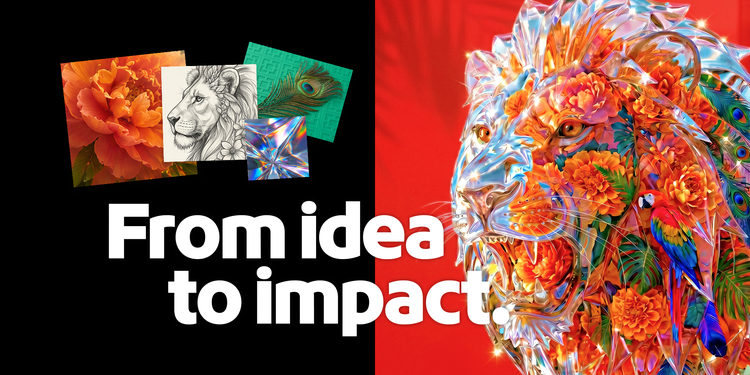
Every June, thousands of creators, marketers, agencies, global brands, and technologists come together at the French Riviera for Cannes Lions — one of the largest annual gatherings of the creative communications industry. What started as a festival about standout work has become a global stage for how creativity, marketing, and AI are converging. It‘s where the smartest ideas in the business meet the energy of a live audience, and where the future of brand building starts to feel very present.
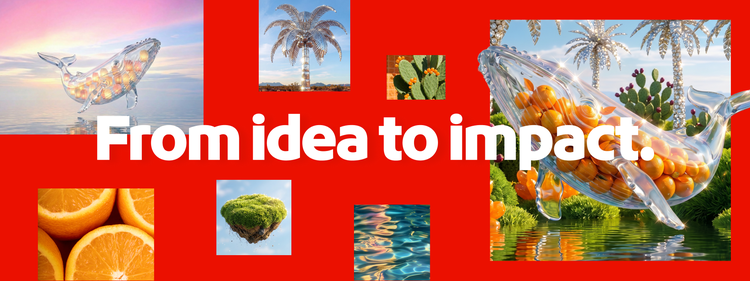
For Adobe, that makes Cannes an ideal moment to showcase the creativity and innovation of our teams and the tools that make the work possible. This year, we built our presence around the theme “From idea to impact” and used our own industry-leading tools — Adobe Firefly, Adobe Frame.io, and Adobe Creative Cloud apps — to help power the experience across the festival. One of the biggest unlocks was Firefly Boards, which let our teams explore more visual directions, generate more variations, and iterate at a much higher level of fidelity from the very beginning.
Pulling off a cohesive, unifying experience at the scale of Cannes Lions takes careful planning and flawless execution, and Adobe’s own tools — especially Firefly Boards — gave our teams a major advantage.
Building a cohesive visual system
Cannes Lions is unlike almost any other event. It unfolds simultaneously across dozens of venues and platforms. For our teams, the challenge wasn’t simply building individual activations. It was creating a cohesive system.
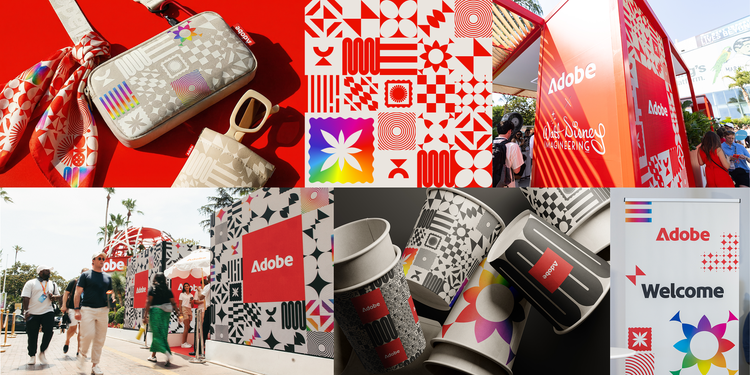
At the heart of that system is our event expression — the colors, patterns, imagery, and typography that allow us to fully brand an event across both digital and physical spaces. It has to work at every scale, from giant hanging installations and city screens to the physical structures that house our activations, and from banner ads and email templates to food menus. That the visual system can hold that massive range together is a testament to our team’s creative operation. We sweat every detail and manage the highs and lows of execution.
This year, we evolved and refined the visual foundation we first introduced at Adobe Summit 2026 and Firefly’s first-ever global brand campaign — which included a takeover of 38 individual screens in Times Square — and adapted it for Cannes Lions. We wanted it to feel brighter, more open, and more reflective of the energy of the iconic palm-lined seaside promenade, the Boulevard de la Croisette, while still unmistakably Adobe.
The visual system was intentionally built to be flexible so we could apply it across the entire festival footprint, and it was one of the first elements we built in the larger event branding process. It then scaled progressively across the work as more assets came online.
Behind the scenes, that meant several teams all working together as one connected creative operation. We also released components of the event expression toolkit to other teams so they could create their own content within the larger system and didn’t have to start from scratch. It helps keep the work cohesive but still requires brand oversight and moderation. We review everything before it goes out into the world.
And that visual system was only one part of the story. Our teams were also concepting and executing product and social activations across Cannes Lions, while also managing a complete out-of-home campaign across a range of city screens, static and video. Each of those efforts is its own mini-universe of strategy, concept, and execution.
Firefly played a central role in the Cannes Lions story. It became the creative engine behind much of the work. One of the clearest examples is the Adobe Boutique, an invite-only experience housed at the famous Majestic Hotel where attendees directly engage with custom activations that blend creativity and self-expression powered by Adobe’s newest and most exciting tech.
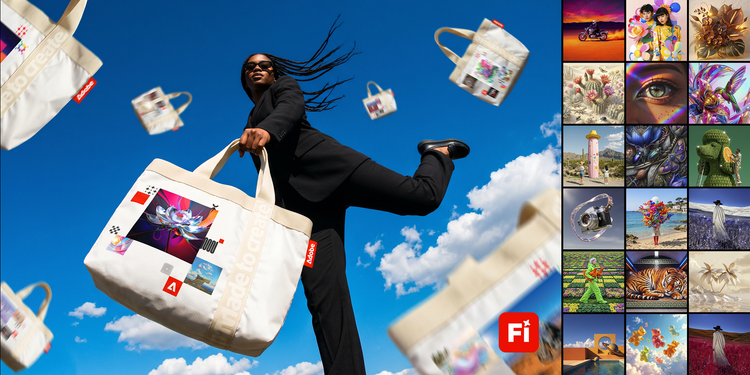
We used Firefly to produce much of the creative content across the Boutique. Guests begin with a quiz experience that creates a visual style aligned with their preferences. From there, they can style a custom premium tote bag using Firefly-generated images inspired by our “Made to Create” campaign.
Beyond the Boutique, our main activation at Creator Beach featured what the team called the “Firefly Camera” (first introduced at our Firefly Times Square takeover) — a self-serve experience powered by the Firefly API that allows attendees to upload or take a photo of themselves and instantly see themselves rendered into a personalized scene tied to Cannes Lions and the vibe of the southern French coast.
What I love about these experiences is that they make creativity participatory. People are no longer passive audiences moving through branded environments. They are participating in the creative process itself. This is where the future of creativity is headed.
AI expands the creative process
Of course, AI can help teams move faster, reduce production timelines — scale content. But I think the more important shift is much deeper.
Adobe’s work for Cannes Lions demonstrates how AI can expand the creative process — opening more possibilities and allowing us to work with more precision.
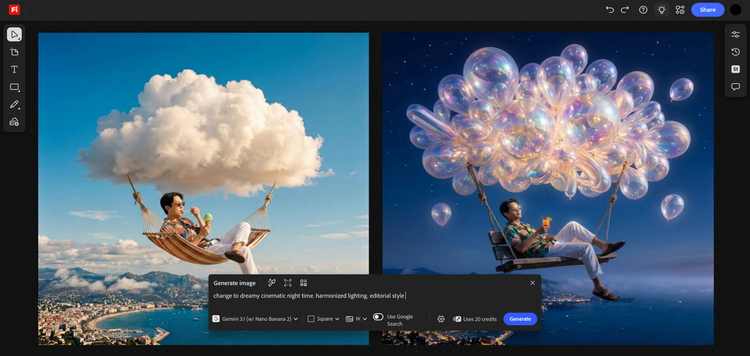
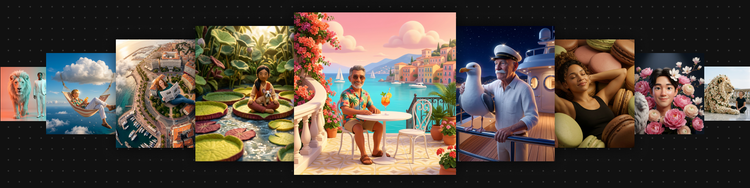
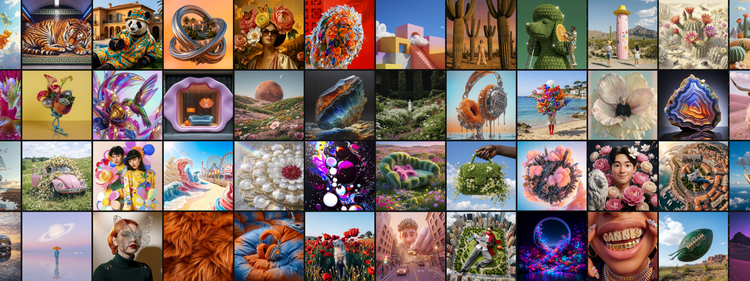
Firefly Boards turned out to be a real game-changer here. It gave the team a much more fluid way to work. It opened up a wider range of visual directions early in the process, helped us build more variations quickly, and made it easier to refine the work at a high level of fidelity before moving into production and review cycles. The number of images we could create is astounding, and at the same time, we could add motion to all of them.
The goal is to harness AI to produce better, more cohesive work — work with stronger craft, clearer intent, and more meaningful audience engagement.
That’s the difference between automation and creative amplification.
Connecting the workflow from idea to execution
Any large event with the scale and visibility of Cannes Lions is a significant operational challenge.
Our teams had to manage a massive volume of creative assets. The Cannes build included 151 print deliverables across 81 unique aspect ratios, with the largest piece measuring roughly 46 by 31 feet. On the motion side, the team produced 173 videos across 24 different screens, including 70 unique videos in 17 unique dimensions. Altogether, the project used 100+ unique Firefly images and videos and rendered more than one million frames — generating 1.19 TB of data across 206,824 files and 2,248 folders.
A project of this magnitude required intense collaboration, coordination, review rounds, and approvals.
Frame.io was the backbone for our process — and our success.
Our teams built the creative assets with all Creative Cloud tools from Firefly, Photoshop, and Illustrator, all the way to Premiere and After Effects. The connectivity between the tools is the key. They then used Frame.io to manage assets, review content, approve iterations, and coordinate workflows across multiple teams, partners, and physical environments.
That connected workflow is becoming essential for modern brand building.
From idea to impact
For years, the industry talked about creativity primarily as an output: the campaign, the asset, the film, the social post.
But increasingly, creativity is becoming infrastructure. Cannes Lions 2026 is not just one of the world’s biggest creative stages for Adobe to show up on. It’s a chance to show how our own technology can create cohesive visual systems end to end — from first idea to finished experience.
The bigger story we wanted to tell this year is about what our tools make possible when they’re connected by a clear point of view. At a time when so many brands are trying to move faster, create more, and stay relevant, the real advantage lies in building an AI-powered creative system that can do all three without sacrificing quality.
From idea to impact is more than a theme. It’s the way modern creativity has to work.