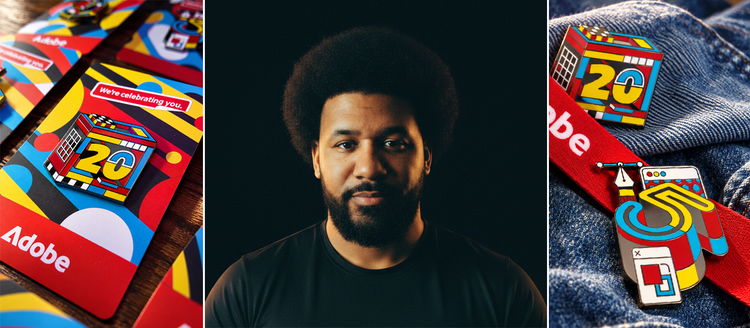
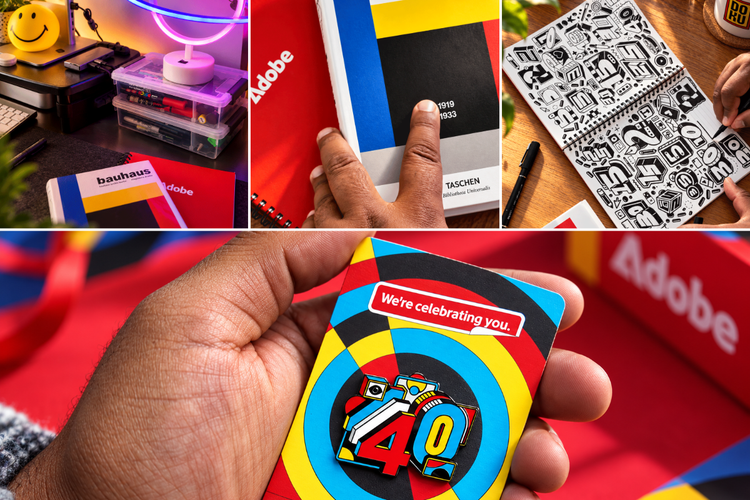
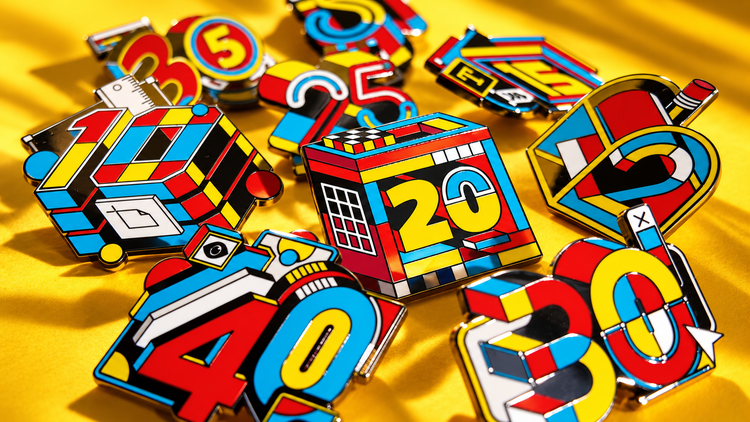
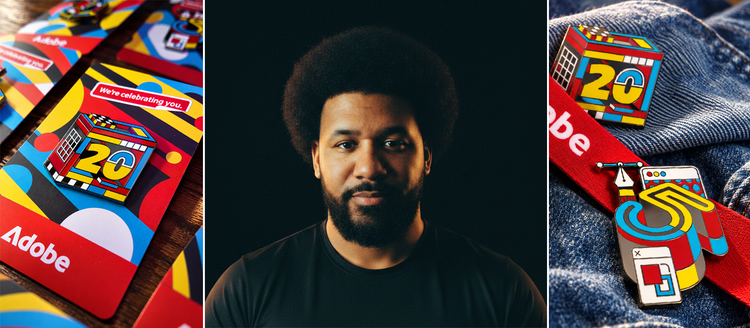
Every year at Adobe MAX, we hand out special enamel pins that commemorate how many years attendees have been creating with Adobe tools. This year, our tradition reaches a milestone of its own: It’s the fifth year of the Adobe member anniversary pins.
These pins are our way of thanking you, our customers. They’re also a chance to highlight and uplift the artistry and talent of our community, as we partner with a different creator to design the pins each year. This time it’s David Oku’s turn, a London-based illustrator, animator and multi-disciplinary creative working across illustration, digital design, motion, and creative direction. He describes his style in two words: “Digital Macedonia.”
“It’s a lot of influences, shapes, colors, and ideas coming together,” he explains. “I was born in Germany with Nigerian and Italian roots, and that mix has always influenced how I see color, composition, and storytelling.”
David follows in the footsteps of previous pin designers Carra Sykes (2022), Jessica Miller (2023), Marlene Vega (2024), and Tyler Pate (2025). Last year's pins looked to American design history. This year, David brings a European influence: the Bauhaus.
Heading to Adobe MAX in Miami Beach (November 10 to 12)? Swing by the Community booth to collect the pin that matches your years of creating with Adobe.
David Oku revealed his design of the 2026 Adobe member anniversary pins at a Adobe Live session, where he walked us through his process and workflow, including a live demo of designing an enamel pin.
From first experiment to creative mastery
The 2026 collection draws on the Bauhaus color aesthetic and, in particular, the school’s learning path. The pins nod to the thinkers who shaped the movement: Johannes Itten’s foundational teaching, Herbert Bayer’s universal typography, Wassily Kandinsky’s color vision, and Walter Gropius’s belief in “art and technology: a new unity.”
“The starting point was the Bauhaus and the idea of ‘creative mastery through progression,’” says David. “I was fascinated by how Bauhaus students moved from experimenting with basic form, color, and material into specialized craft, and eventually towards a point where different disciplines worked together almost instinctively. That felt very similar to learning creative software. At first you’re consciously learning every tool; years later, the tool almost disappears, and you’re simply creating.”
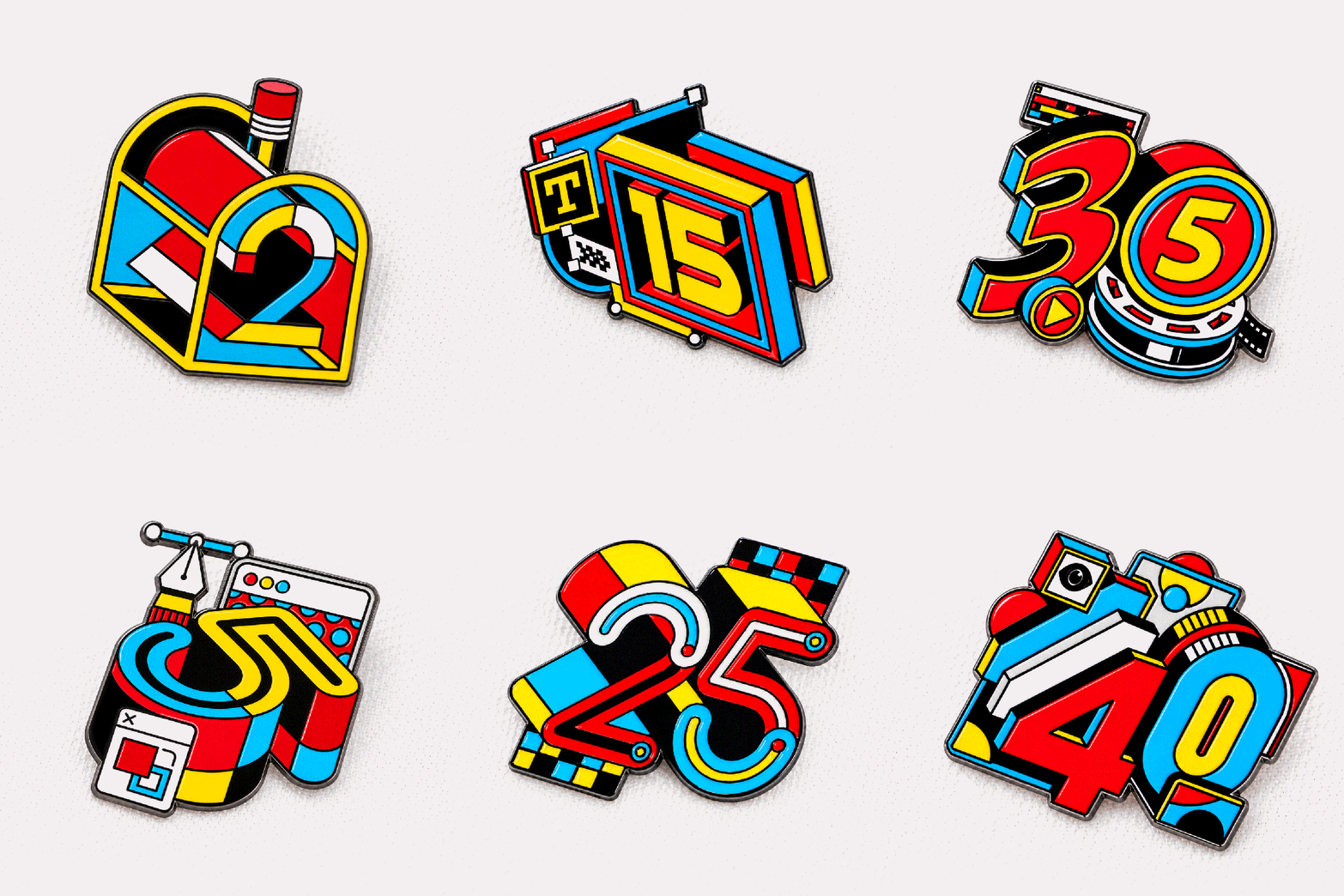
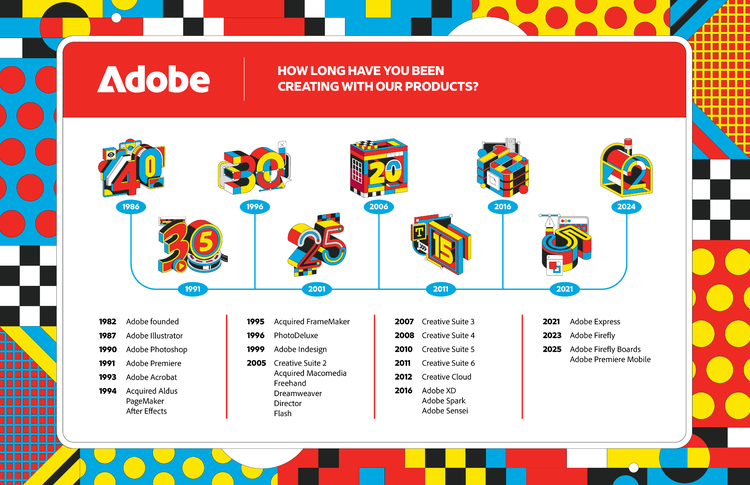
That idea became the story of the collection. “I wanted the nine pins to tell that story visually, from discovery and experimentation through confidence, fluency, and synthesis.”
Each of the nine pins is built around an Adobe Illustrator tool or panel that defines its stage, from the tools featured in the two-year pin to the panel found inthe 40-year one. Each pin comes with a backcard that shares the same world of typography, grids, color, and geometry. The 35-year pin also tips its hat to a big birthday: Adobe Premiere, which turns 35 this year, inspired David to design a Premiere timeline, film reel, and play symbol alongside the layered 3D numerals.
For David, the most rewarding part of the project was finding the connection between the Bauhaus workshops of the 1920s and the creative tools we use a century later. "Technology has changed dramatically, but the creative journey is surprisingly similar," he says. "We experiment, learn, repeat, develop confidence, and eventually discover our own way of seeing." Turning that idea into pins that thousands of creatives can wear at MAX, he adds, "feels very special."
Building a visual system
David’s process began away from the screen. “I went back to one of my favorite Bauhaus books and looked at the typography, architecture, color relationships, and geometry during that era,” he explains. “Then I filled pages of my sketchbook, stretching, rotating, dividing, and rebuilding ideas.”
Once the system started to emerge, he moved into Illustrator. “That became the main tool for developing the collection, turning rough ideas into precise vector forms, structured compositions, and production-ready artwork. Working with vector shapes, alignment, grids, anchor points, and layers allowed me to build everything very precisely while still experimenting freely.”
Layers were important conceptually as well. “As the anniversary years increase, the designs become more dimensional and interconnected,” David points out. “That layering represents accumulated experience — every experiment, mistake, shortcut, and breakthrough builds on what came before.”
The biggest challenge was making nine individual pins feel different while still clearly belonging together. “Rather than thinking of them as nine separate illustrations, I started treating them as one evolving visual system,” David says. “The ingredients — geometry, typography, color, and Adobe-inspired details — stay consistent, but their relationships become more sophisticated as the years progress. Together, they form a visual timeline of creative development.”
Hidden details and personal milestones
As every year, the collection is packed with easter eggs. “I love hiding details in my work, so there are references throughout the collection to things creatives interact with every day,” David reveals.
“Illustrator anchor points and Bézier curves, selection boxes, bounding frames, vector paths, crop and registration marks, cursor shapes, grids, alignment guides, layers, and interface-inspired geometry. Some are obvious, and others are buried within the compositions. I wanted people to discover something new when they looked twice.”
David’s favorite is the 40-year pin. “It represents synthesis, the final stage of the idea. By that point, typography, color, geometry, structure, and technology are all operating together,” he says. “It represents the moment where mastery isn’t about knowing every feature anymore. It’s about knowing what matters and being able to make the tool disappear behind the idea.”
This year, David will be wearing the 25-year pin. “I was first introduced to Photoshop and Illustrator while I was still studying, and that discovery completely changed what I thought was possible creatively, “he shares. “Drawing had always been natural to me, but suddenly I had a way to translate those ideas digitally, experiment faster, and eventually move into animation as well.”
Over those 25 years, David has gone on to work professionally, speak at Adobe events, design merchandise, and mentor emerging creatives. “Receiving my own 25-year pin this year feels especially personal. It represents a huge part of my creative journey.”
Wear your years
The magic of the pins comes less from the enamel than from the stories you share when you pick yours up: fond memories of first projects, new careers, and years of making things. We shared some of our favorites in last year’s post-MAX roundup.
David feels the same way. “They’re tiny objects, but the number on each one carries somebody’s personal creative history, and the experience behind it is shared,” he says. “Someone receiving a two-year pin and someone receiving a 40-year pin are at very different stages, but both belong to the same creative continuum. I love the idea that these pins become little workshop credentials, something that says, ‘This is how long I’ve been creating.’”
So what does David hope you’ll feel when you pick up your pin? “First, I hope attendees enjoy the pins themselves, the color, geometry, and small details. Then I hope they look again and start discovering the hidden references. More importantly, I hope they feel proud of the number they’re wearing.”
Pick up your pin in Miami Beach
What’s behind your number? Stop by the Community booth at Adobe MAX in Miami Beach (November 10 to 12) to collect your pin. Attach it to your shirt or bag, then share a photo and your story on social tagged with #AdobeAnniversary. We can’t wait to see them!
Register for Adobe MAX.
Join us at Adobe MAX in Miami Beach, or for MAX Online.
November 10–12, Miami Beach and online
Register for Adobe MAX 2026.