Many 3D studios and product teams face a common challenge: How to scale content production without compromising visual quality, consistency or speed. Our experience growing the Substance 3D Assets library shows how the use of USD and automation can solve this common problem.
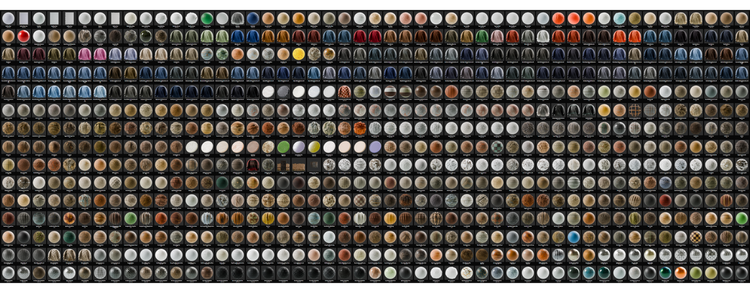
The Substance 3D Assets library features thousands of materials, models, and scans deployed by users to power production workflows in games, VFX, and digital twins for product visualization. As the demand for new assets has increased, our Adobe production team had to create content even more quickly than before.
With the USD standard adoption in the Substance 3D tools and newly implemented automation scripting capabilities, the team decided it was time for a revamp.
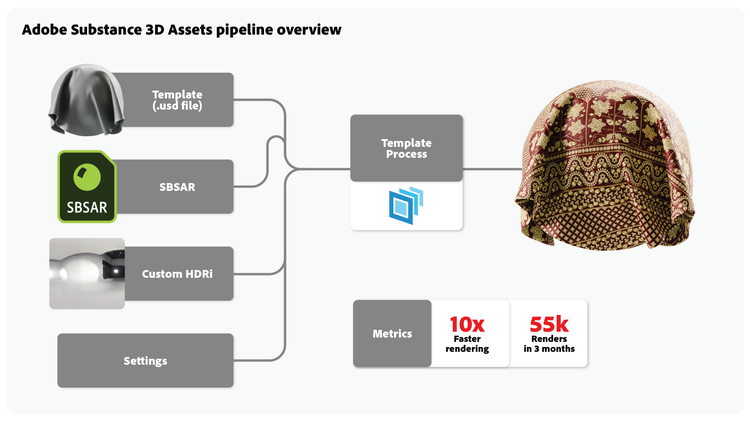
The result was a rebuilt, USD-first, automated rendering pipeline designed to be scalable and production-ready, enabling the team to make more than 55,000 renders within just three months and improving processing and render speed tenfold.
With its reliance on open standards like OpenUSD and OpenPBR and commonly available scripting tools, this streamlined process is one most production teams can adopt to supercharge their own content stream.
How to implement an automated pipeline
An automated pipeline can be replicated across a wide range of use cases. With OpenUSD support and Substance 3D scripting capabilities, teams can build customizable pipelines tailored to their needs.
The first step is to standardize assets: Agree on materials defined in OpenPBR, and geometries and scenes described in OpenUSD, structured through templates that account for variations in shape, material, and lighting. This foundation enables the generation of thousands of renders from a single dataset, independent of tools or render engines, while ensuring consistency across the asset lifecycle.
The second step is to industrialize production through automation. Scripting tools in Substance 3D and third-party solutions enable users to assemble scenes, presets, and rendering parameters automatically. Powered by GPU-accelerated, multi-engine rendering pipelines, deployable on render farms, teams can scale production efficiently across contributors and departments.
Together, these capabilities enable systematic, reproducible, and scalable content generation, significantly accelerating production, improving quality, and supporting rapid iteration.
Applicable across industries, from CPG and automotive to VFX and fashion, this approach supports both material libraries and full product assets. Standardized assets simplify comparison, validation, and decision-making across creative, technical, and business teams.
Ultimately, this pipeline delivers faster production, stronger visual consistency, and long-term scalability, establishing a robust foundation for industrialized digital twin workflows aligned with evolving 3D standards.
A familiar scaling challenge for asset-heavy workflows
As with many studios, Adobe’s pipeline of content for the Substance 3D Asset library had grown organically over time. To render the assets for visuals and thumbnails on the platform, it relied on a single renderer and custom scripts that were difficult to maintain and evolve. Preparing materials for rendering often required lengthy manual steps and reliance on external infrastructure.
“The tools worked, but the pipeline wasn’t built to scale,” explained Paul Parneix, who leads asset capture and rendering workflows for Substance 3D Assets. “As the library grew, we needed something more flexible, more automated and easier to adapt to new standards.”
This is a challenge that many teams face when working with large libraries of digital twins, materials or scanned assets, especially when those assets need to remain consistent across multiple renderers, platforms and formats.
Assets rendered with old vs new pipeline
Why USD and automation became the foundation
To address these limitations, Parneix led the team’s efforts to rebuild the asset rendering pipeline around two core principles: using OpenUSD as the scene description foundation and building automation to create thousands of assets with minimal manual intervention.
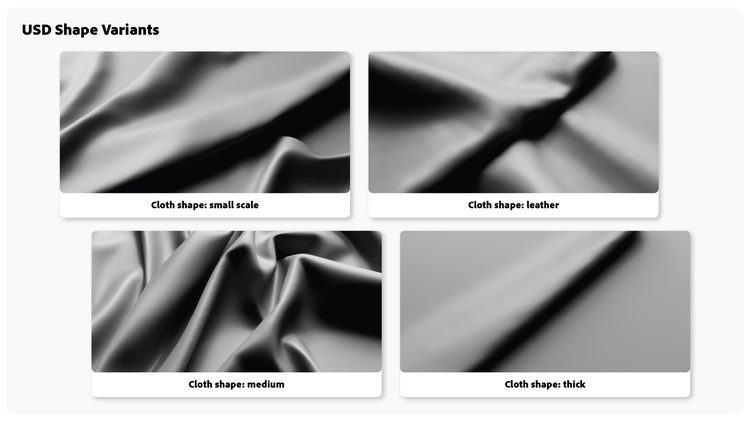
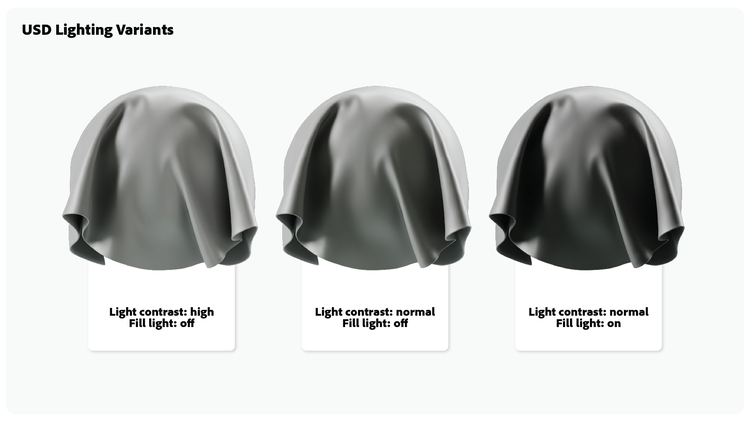
The .usd file works as a template where artists can select different presets (variants) to define scenes, materials, and lighting. Once these variants are selected, the automated process generates a lightweight USD scene. This scene is then processed for the chosen render engine. The OpenPBR material format ensures that assets look consistent across different render engines.
This automated pipeline also takes advantage of recent advances in rendering technology to further improve both speed and visual quality. “We accelerated the rendering process tenfold thanks to GPU rendering and denoising; we can render with multiple engines, on CPU or with our NVIDIA GPUs,” Parneix said. “Furthermore, displacement is now super accurate thanks to physical size and UV/3D scale ratios.”
Speed, scale, and consistency
The impact of the new pipeline was immediate and measurable. Using the automated, USD-first setup, the team produced roughly 55,000 renders for the platform in only three months.
For one material, the entire process from scene setup to render is now done in 10 minutes, whereas it previously took one to two hours, providing an average tenfold increase in speed. Just as importantly, faster rendering enabled more iteration and higher overall quality.
“At this scale, speed isn’t just about costs and efficiency,” Parneix said. “It directly impacts render quality. The faster you can iterate, the better the result.”
A repeatable playbook for asset-heavy workflows
While this pipeline was built to support Adobe Substance 3D Assets, the same combination of OpenUSD for scene definition, OpenPBR for material consistency, and automation for speed and scaling can be adopted by studios and teams facing similar challenges with large volumes of digital twins or assets.
As digital twin workflows continue to expand across industries, Adobe’s customer zero experience can be applied to a wide range of use cases, from e-commerce product views and product variations to asset validation turntables and beyond. By building pipelines around open standards and automation, teams can future-proof their workflows and scale their content production efficiently and consistently.