Big scale. Big ambition. Short deadlines.
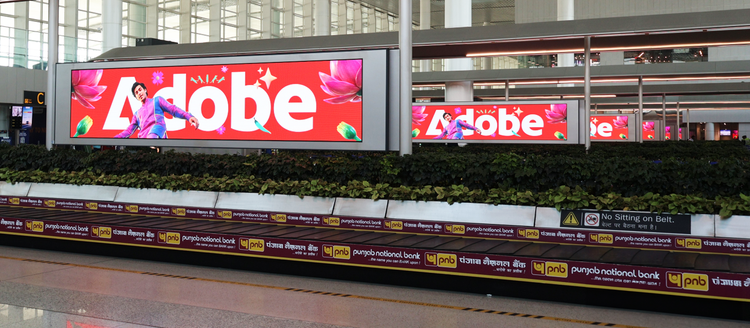
That was the reality behind "India Go Big," an ambitious out-of-home campaign across Delhi, timed with the India AI Impact Summit in February. The challenge was clear: design a striking, unmistakable series of ads throughout major transportation centers in Delhi — a city renowned for its vibrant visual heritage. The project aimed to spotlight Adobe's prominent role and impact in India across creativity, productivity and customer experience.
What made it possible was a new way of working — one built around Adobe Firefly Boards as a shared creative space for distributed teams across Delhi, Sydney, London, and Mexico City. Instead of passing files back and forth across time zones, teams could explore directions together in real time, react to each other’s ideas visually, and move from concept to decision faster than traditional workflows have allowed. Any team navigating tight timelines, remote collaboration or the pressure to do more with less creative bandwidth can work the same way.
The brief: Tradition, modernity and the future
At its core, the ask was simple to say but complex to deliver:
To show Adobe as the company making creativity and AI accessible at scale — for professionals, students and the next generation of creators in India. This isn’t about flashy tech demos or abstract AI visuals. It’s about presence, relevance, and trust.
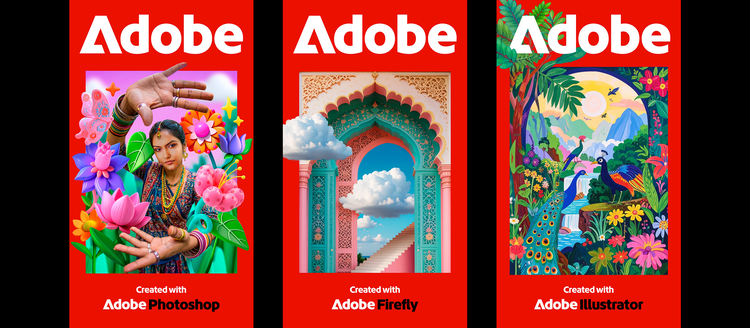
The team built on Adobe’s global brand platform “Made to Create.” The challenge was to adapt this framework for local cultural relevance, while scaling seven different executions across more than 30 placements in the city.
To execute on this vision, the team needed to move fast in close collaboration with partners at Dentsu Creative and an international crew scattered across Delhi, Sydney, London and Mexico City. A robust operating model was essential for seamless sun-to-sun iteration across time zones.
And the most important part: The team needed to get the cultural nuance right, not as an afterthought, but as the foundation.
How Firefly Boards enabled a distributed creative team to scale their work
Adobe’s brand system is open and super flexible, and it often serves as a blank canvas for many forms of creativity. In this case, image creation would be heavily influenced by modern Indian creative culture. The local team provided a perfect brief: a blend of modern India, contemporary visual culture, maximalism, color, and references to rich heritage seen from a fresh perspective.
And this is where Firefly Boards — an AI-powered surface for ideation and collaboration that is part of Firefly’s all-in-one creative AI studio — became an essential tool for this work.
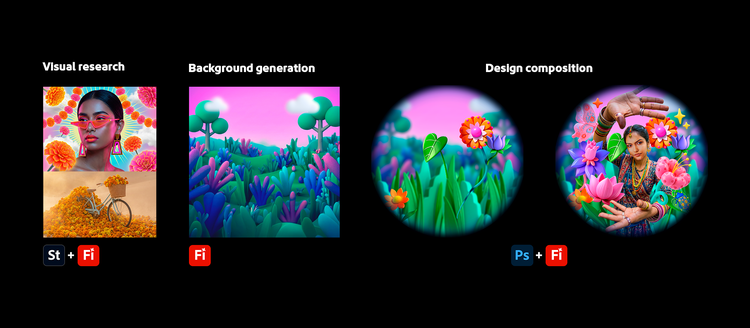
Used as a collective thinking space, Firefly Boards – which brings together industry-leading creative AI models including Google’s Nano Banana 2, Veo 3.1 and Runway’s Gen-4.5 — gave the distributed teams at Adobe and Dentsu a place to exchange references, visual briefs, and expectations for what the creative vision could become.
As a real-time, image-making environment, it allowed the team to generate visual directions, modular elements, patterns, and stylistic variations — not as finished assets, but as conversation starters. This made it easy to incorporate stakeholder feedback, generate variants based on live input and see them materialize in seconds while keeping everyone aligned under one creative vision. It also helped the teams to:
- Explore references freely, without committing to outcomes
- Expand to areas that the small and nimble team didn’t have the capability to do manually
- Stress-test tone, color, and composition, together in one place
- Thanks to access to different partner models, explore different inputs based on different data sets.
- Quickly address stakeholder feedback, by generating alternative images on the go
- Instantly bring static models into video, in a single space
Pixel-perfect refinement in Adobe Photoshop
Once directions crystallised, the work moved seamlessly into Adobe Photoshop, where the teams refined, extended, and adapted visuals for real world production across billboards, bus shelters and other out-of-home placements. If an image needed a small tweak the team used Generative Fill in Photoshop, to select specific areas to refine and generate new elements. And they could do it using the Adobe or third-party models available within both Firefly and Photoshop.
Through it all, the project management team used Adobe Workfront to help move reviews forward and keep everyone on track with a single-source of truth.
The result? Hundreds of images, dozens of creative routes, multiple locations… delivered at speed, without creative dilution.
And even more importantly: Everyone got to contribute and feel ownership over the process.
A better way of working
Seeing the work come to life as a celebration of Delhi's thriving ecosystem was a huge victory. But the real success was to give teams a better way to collaborate.
This project reinforced that AI doesn’t make creativity less human. It facilitates and accelerates ideation and collaboration across teams and geographies. When everyone gets the chance to express ideas, everyone feels part of a more collaborative process.
When used well, tools like Firefly Boards:
- Lower the barrier to collaboration
- Make thinking visible
- Encourage free experimentation across teams, enhanced by AI
Within a few hours of live collaboration, the team produced 450 unique images to populate seven artwork-rich creative variations, which lived across 60+ formats and placements.
In the past, delivering a project at this speed would have meant a lot of sleepless nights for a small team. Thanks to Firefly Boards, the teams were able to ideate fast, scale further and sleep better.
Ready to explore Firefly Boards for yourself?
Getting started is simple — Firefly Boards is available to anyone with an Adobe account. Visit firefly.adobe.com to create your first board. For teams looking to unlock unlimited boards and the full suite of generative AI features, explore Adobe Firefly plans.