AI can be one of the most powerful creative tools for an artist. It can expand what is possible for designers, illustrators and creators of all kinds — accelerating ideas, opening new mediums, and lowering the barriers to creative expression. At Adobe, our fundamental mission is to empower creativity, and we know human creativity can be supercharged by AI. But every powerful tool can be misused — and AI is no exception.
With AI, anyone can use a single prompt to generate mass imitations of an artist’s signature style and flood the marketplace with those outputs — at zero cost, in seconds, and without consent or compensation. That's the reality and threat that is facing visual artists today. And until now, the law has had no answer for it.
That changes today, with the introduction of the CREATOR Act (Creative Rights for Artists' Technique and Originality Are Reserved Act). If passed, this common-sense, bipartisan measure would address a gap in our intellectual property laws by protecting creators against style impersonation, and Adobe is proud to support it.
Because we believe AI and human creativity can flourish together — but only when creators have rights that match the realities of the technology.
Overcoming the legal gap
Developing a signature artistic style takes years of practice and dedication. Artists have to hone their technique, their sense of color and tone, their capacity to express an emotion or an idea and ultimately their creative decision-making process. Over time, these skills give way to a style that becomes something unmistakably distinctive. For many creators, it is their identity in the marketplace and central to their livelihood.
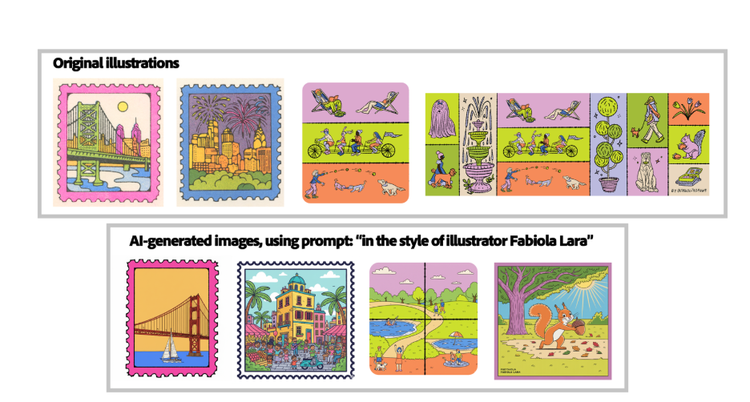
Take Fabiola Lara for example. She’s an illustrator based in Philadelphia who had an AI platform approach her with AI-generated images impersonating her work to showcase their technology — without asking for permission. The ease with which these AI images were generated pose a direct threat to her artistic identity and livelihood.
Inspiration is one thing. But this was impersonation. And Fabiola isn’t alone.
Artists have always learned from and influenced one another. Creative styles have evolved through shared techniques, references and movements. But AI systems can now automate imitation at a scale and speed in a way that is fundamentally different from traditional artistic influence. Our existing legal frameworks are not equipped for this reality.
Copyright protects what you make, but it doesn't protect your visual identity or style. Existing law and some new legislative proposals address voice and likeness — but not a visual artist's distinctive aesthetic. There are no existing frameworks that were designed with AI-scale style replication in mind, and in the age of AI, that gap leaves creators and artists increasingly vulnerable.
What the CREATOR Act Does — and Doesn't Do
The CREATOR Act closes that gap with precision. It establishes a federal right protecting visual artists' signature styles from intentional, commercial AI-enabled impersonation. It gives creators meaningful recourse — the ability to seek damages and demand that the impersonation stop.
Importantly, the bill is carefully scoped and narrowly focused. It goes after the bad actor who knowingly uses AI to fake an artist's identity for commercial gain. It does not restrict artistic influence, parody, fan work, or broad AI research and development. It focuses specifically on deliberate commercial impersonation of identifiable artists.
That is the balance that matters — protecting human creators without inhibiting innovation.
Why Adobe Supports This Bill
Creators should have meaningful control over how their work and creative identities are used in the age of AI. For years, Adobe has advocated for creator-first AI policies — including the establishment of clear paths to secure copyright protection for creators who use AI as part of their process.
We co-founded the Content Authenticity Initiative — now more than 6,000 members strong — to bring transparency to digital content and attribution and credit to creators and artists. Now more than ever, creators need practical solutions like Content Credentials to indicate how want their work to be used in AI training.
The CREATOR Act would be a new arrow in the quiver, helping to ensure that the creative economy that feeds AI innovation isn't hollowed out in the process. We commend Representatives Van Duyne, Clarke and Foushee for introducing this legislation.
They're addressing something that affects every creator working today — and by extension, every industry, brand, and platform that depends on human creativity to thrive. We urge Congress to move quickly to advance this important bill.
The Stakes Are Bigger Than They Look
This is not just a creator issue. The creative economy generates enormous economic value, contributing $1.2 trillion — about 4.2 percent of U.S. GDP — to the American economy each year. The artists, designers, photographers and illustrators who power that economy need to be able to sustain their careers and livelihoods. If AI impersonation erodes their ability to do that, we all lose.
An artist's style is the product of years of creative work. The CREATOR Act says that work deserves legal protection. We're glad to see momentum for the law to catch up with technology — and we'll keep working to make sure it does.