Nothing says marketing like Times Square. There have been plenty of brand takeovers. But until you execute one yourself, you don't understand the scale.
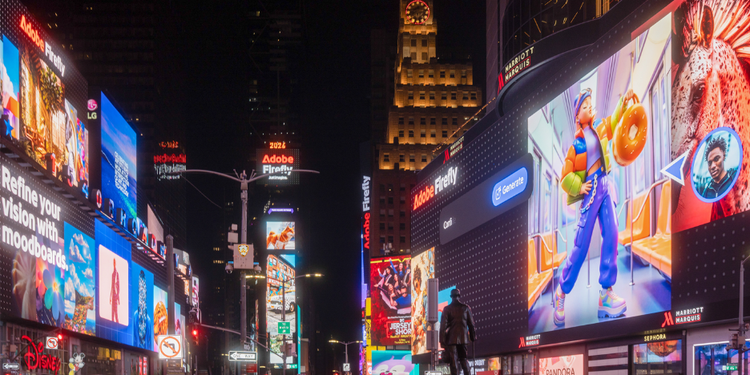
Thirty-eight individual screens with 30 different aspect ratios effortlessly synchronized across six New York City blocks in perfect lockstep, including an interactive onsite activation.
Adobe Firefly’s Times Square takeover this past spring was our largest AI-powered creative showcase to date. Built as part of Firefly’s first major brand push, the “Just Imagine” campaign, the takeover featured 392 unique Firefly images and videos, 3.8 hours of unique content, and more than 3 million rendered frames, resulting in 20 terabytes of data.
Months later, it's still the clearest proof I've seen of what happens when you put AI-powered creative tools in people's hands at scale — so it's worth walking through how it came together.
Some of the artwork displayed on the billboards had been created by employees, some by the community, and some by 23 influencers — representing roughly 90 million combined followers — that Adobe had invited to the Webby Creator Weekend. They generated 70+ assets, and a roster of eight artists also produced on-the-ground content to engage attendees.
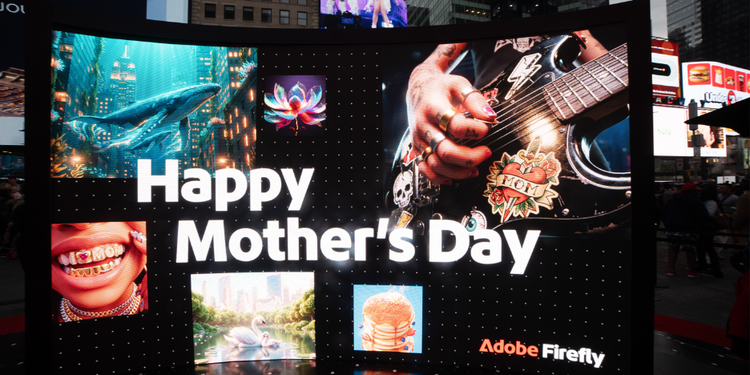
On street-level, the all-day activations spanned creator events, digital galleries, and live experiences, including 20 self-serve stations where visitors could try Firefly for themselves. Specifically, they could personalize a selfie, choosing from 16 styles inspired by New York City and the campaign aesthetic, and generate a unique output in under a minute. Their image was then published directly on massive 12-foot high-definition LED screens we called Dream Boards that surrounded the Times Square activation.
It’s hard to make it to Broadway. Creating, organizing, and delivering such a cohesive experience on such a massive scale was something that only Adobe and Firefly could have achieved.
Where great ideas begin
Every creative idea starts the same way: as a possibility. A spark. A sketch. A “what if” thought that may or may not become something bigger.
That simple truth sits at the heart of Just Imagine, which celebrates the creative process in all its messy, nonlinear glory. Creativity rarely moves in a straight line. It evolves through experimentation, iteration, and unexpected breakthroughs. Firefly is designed for that reality — helping creators move from idea to impact without losing their vision along the way.
We had an opportunity to bring that idea to life on one of the world’s biggest stages.
Closing out Creator Weekend ahead of the Webby Awards in New York City, Adobe transformed Times Square into an immersive Firefly experience. Together, the different moments extended the Just Imagine campaign beyond advertising and into culture, bringing creators, technology, and creative expression together in a way that felt authentic to both the Firefly brand and the creator community.
What made this moment especially meaningful was not just what the audience saw. It wasn’t the scale but the source. The work didn’t come from a single art-directed vision. It came from people using Firefly to make something genuinely theirs.
Building an experience at unprecedented scale
“Just Imagine” celebrates the creative process — turning wild ideas into real impact. What better way to showcase the power of imagination than to make our own wild idea come to life?
At 8:30pm every screen of the billboard takeover suddenly came alive — some carrying motion, others imagery, others transition between movements. Individually, each screen had to be unique and compelling, from 12 feet to the largest at 200 feet. Collectively, they needed to feel synchronized, connected, and intentional for a full hour show: one cohesive story unfolding across Times Square in real time.
There was no better tool than Firefly to help our teams bring this vision to life, from wild idea to visual symphony.
The team used Firefly Boards during ideation so they could explore a much broader range of visual territory and refine ideas collaboratively — instead of starting with a small set of directions — before moving into production.
That process proved especially valuable because Times Square demanded content at a scale that would have been difficult to achieve through traditional workflows alone.
Firefly text to image helped create hundreds of bespoke visual assets tailored specifically to the environment. Firefly image to video helped transform static imagery into motion content designed for massive digital surfaces. And Firefly’s image editing capabilities meant that the editing process became very fluid, allowing teams to remix and replace visuals. The Firefly API, meanwhile, was used to create the custom-built Firefly Camera activation.
A lot of the work began with existing campaign assets, but we had to adapt, expand, and reimagine them so they felt right for Times Square. The campaign also needed new imagery that was referential to the location, new motion treatments, and new compositions that could stand up on giant screens while still feeling connected to the broader “Just Imagine” identity.
When people talk about AI, the conversation often starts with efficiency. But the value isn’t simply moving faster. It’s creating work that might not have been possible otherwise.
The workflow behind the work
Of course, none of this happens without an extraordinary amount of coordination behind the scenes. Large-scale creative work like this only happens when the workflow is as considered as the final output.
The screen-specific work kicked off only weeks before the event, compressing our timeline to finalize the creative direction, gather assets, and translate everything into a synchronized experience across dozens of screens. To increase the difficulty, we even added new topical content just days before we went live. We had to build, review, and ship hundreds of assets in a fraction of the time it typically takes.
That’s where Firefly and Adobe Frame.io became essential partners in the process. Firefly let us move quickly from concept to creation. And Frame.io was critical for sharing assets, routing feedback, and managing approvals across our internal teams and outside partners.
That connectivity allowed teams to maintain momentum while ensuring creative quality remained high throughout the process. It’s the kind of work audiences never see, but it’s often what makes ambitious creative projects possible.
A stage for what Firefly can do
What I love most about the Times Square takeover is that it reflects something larger than a campaign.
It demonstrates what you can do when creators have tools that help them move from inspiration to execution more easily, more collaboratively, and at greater scale.
“Just Imagine” began with a simple idea: Creativity is messy, and that’s where great work comes from. The Times Square takeover brought that idea to life.
It showcased real creative output on one of the world’s most visible and most iconic advertising canvases. It transformed participation into creative expression. And it showed how AI can support creativity by helping people explore, refine, and realize their ideas. There's been a lot of conversation about what AI means for creativity — whether it shrinks the opportunity or expands it. The Firefly Times Square takeover answered that question. Creativity isn't going anywhere. If anything, it's more alive than ever.