Running a large marketing organization at scale is a bit like driving at high speed: the faster you go, the more precisely you need to see.
The problem most organizations run into isn't a lack of drive or effort. It's that they're trying to make real-time decisions from a dashboard that isn't showing them the full picture.
That was the challenge facing Adobe’s Marketing Science and Planning team, a critical group within my organization that helps guide major marketing investments worth billions of dollars.
The Marketing Science and Planning team’s job requires coordination across extensive datasets, evolving models, multiple agencies, and dozens of stakeholders worldwide. This way of working had become hopelessly outmatched.
They needed a new operating model that could connect strategy, planning, and execution end-to-end, and lay the foundation for something more.
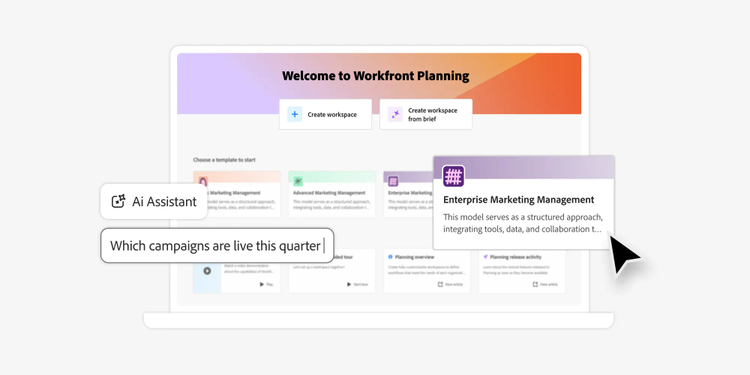
That’s where Adobe Workfront Planning comes in, a single solution that plans and orchestrates work for your organization by connecting moving pieces directly to execution workflows.
Incredible work choked by fragmented systems
The Marketing Science and Planning team lives and breathes sophisticated models.
These models forecast investments, like full-funnel paid media, across products, channels, and markets; from how much to allocate to search ads versus social platforms like LinkedIn and Instagram, to how to shift spend toward the regions and products with the most opportunity.
This means that every 13 weeks, they deliver or update their models for demand creation, channel optimization, regional growth strategy, and measurement, all while coordinating across data scientists, marketing planners, engineering, operations partners, and business stakeholders.
The dependencies are just as incredible: data must be prepared, engineering completed, inputs aligned, and models built, reviewed, and validated.
It's a tightly wound process with very little room for error, like a data factory churning out a new supercar every few months.
Since the work was scattered across systems and conversations, teams couldn’t see progress, emerging risks, or trade-offs until problems surfaced. When quarterly planning came around, it was a daunting challenge, and incomplete requirements made it hard to gauge effort and capacity.
It’s a pattern many enterprise marketing teams know all too well.
From quarterly planning to a connected operating rhythm
To make better investment decisions, we needed a connected, end-to-end operating system that could handle a myriad of disparate data and do more than just track and report on projects.
Workfront Planning gave us a single place to align strategy, capacity, and execution. It created a flexible, powerful environment for building and maintaining structured, connected information.
Having everything in one place also enabled the Marketing Science and Planning team to unlock a coordination layer that has always required manual effort.
What previously required hours of manual data entry and cross-checking across systems now happens in minutes. Questions about pipeline status that once required a manual report can now be answered in plain language, directly in the tool.
Instead of a single, arduous quarterly planning session, the team is connected and informed with visibility into a centralized backlog, alignment around clear owners, and direct links between projects, capacity, timelines, and objectives.
Prioritization has become much easier, too. Today, every task ties to a specific objective and ladders up to a strategic goal, making it clear which work is mission-critical and how to manage capacity accordingly.
Someone was already underwater, and we had no idea. That's the kind of invisible risk that doesn't show up until something breaks.
What changed: more focus, more reliability
The data factory didn't slow down. It got better at building.
A good leader knows that a tool is only as good as the hands that wield it. Workfront Planning demonstrated that when you have the right tool in place, it can drive new ideas and culture that transform an organization.
The downstream effects and morale boost are just as important. The team’s reliability and reputation improved dramatically as they consistently met their commitments. Stakeholders across the company could plan more easily now, and the business could move ahead faster and with more confidence.
As one team member put it simply, “Things are so much more organized now.”
Visibility before velocity
At Adobe, we're the first and most demanding users of our own tools. This is what it looks like in practice.
The Marketing Science and Planning team still builds 250 models. They still guide more than $1 billion in global marketing investment across five markets, every 13 weeks. The scale and the stakes haven't changed.
What has changed is the operating model behind it and where we can go. We now have a connected system that links strategy, capacity, and execution in one place, giving every team member a shared view of what's planned, active, or at risk and making hard trade-off conversations fast rather than fraught.
For any marketing leader managing growing complexity with the same or fewer resources, the lesson from my team is clear: visibility must come before velocity.
You can't drive fast if you can’t see the road. Get the operating model right, and everything else, the decisions, the execution, the results, get sharper.
Marketing complexity isn't slowing down. See how Adobe Workfront Planning helps teams connect strategy, capacity, and execution in one place.